
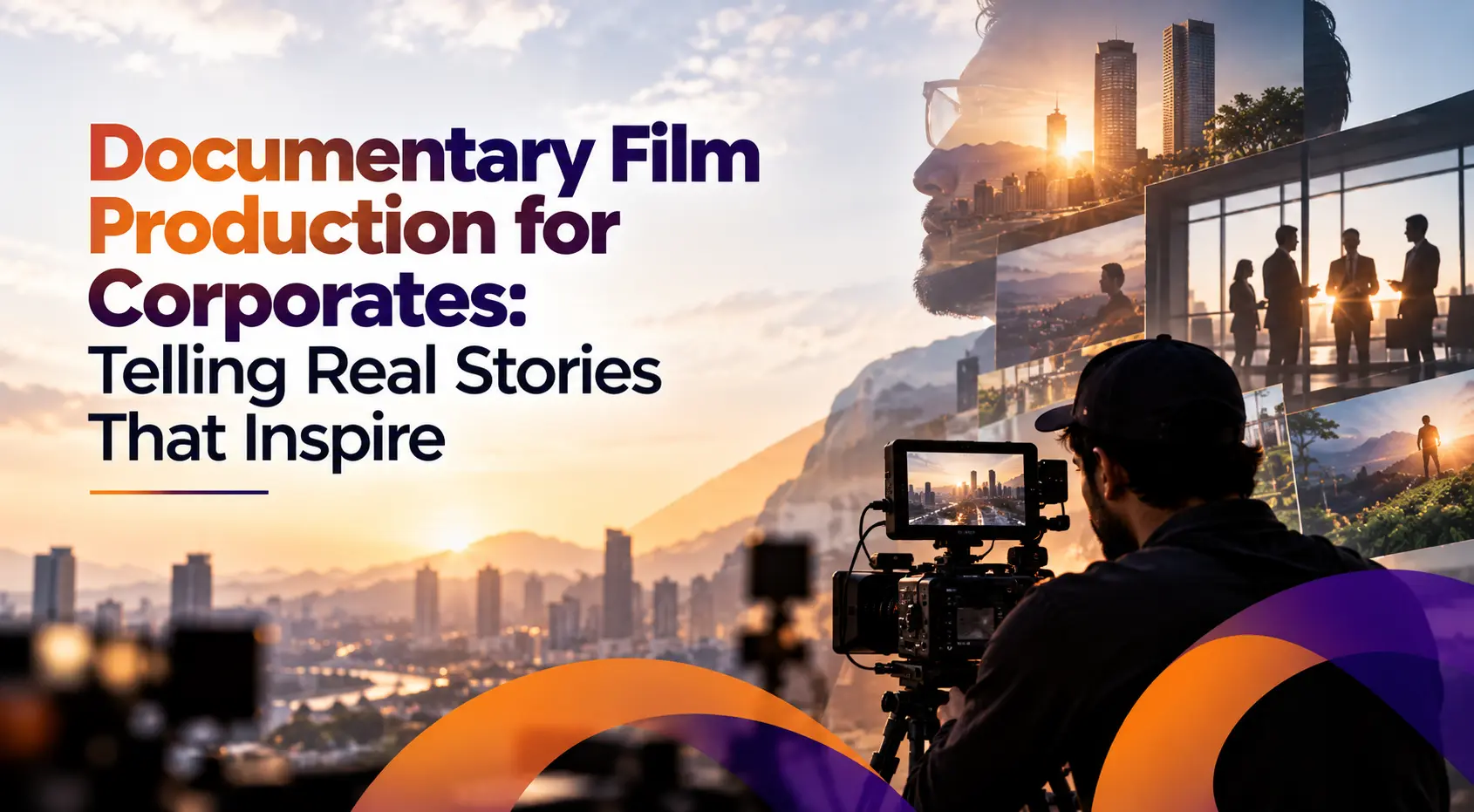
Corporate Documentary Film Production in India
The most powerful corporate story may already exist inside your organization.
It could be the employee who has spent 25 years helping build the company.
The engineer who solved a problem everyone thought was impossible.
The customer whose business changed because of your solution.
The community transformed by a CSR initiative.
The founder who began with an idea, a small team and a much bigger ambition.
Or the people behind a manufacturing facility, healthcare organization, technology company or social-impact programme whose stories rarely appear in a corporate presentation.
These are not advertising claims.
They are real stories.
And when they’re discovered, filmed and told with honesty, they can become some of the most powerful communication assets a company creates.
That’s the purpose of corporate documentary film production.
Unlike a conventional corporate video that primarily explains what a company does, a corporate documentary uses real people, real experiences and real environments to tell a deeper story about the organization and its impact.
For businesses exploring corporate documentary film production in India, this guide explains what a corporate documentary is, when to use one, how it is produced, what it costs and how documentary storytelling can help brands communicate with greater credibility and emotional depth.
What Is a Corporate Documentary Film?
A corporate documentary is a nonfiction film created around a company, organization, initiative, community, person or real-world business story.
The objective is not simply to list the company’s services or achievements. It is to find the human story behind them.
A documentary might follow one person whose life or career was genuinely affected by the initiative.
Instead of saying: “We have been innovating for 50 years.”
The film could combine archive material with interviews from long-serving employees, customers and leadership to show how that innovation evolved.
Documentary filmmaking turns corporate claims into stories people can see, hear and experience.
Why Are Corporates Using Documentary-Style Storytelling?
Audiences are surrounded by brand claims. Every company says it is:
Documentary storytelling gives companies an opportunity to move beyond adjectives. Instead of telling people what your organization believes, you can show them through real experiences.
Corporate Documentary vs Corporate Video: What’s the Difference?
The terms sometimes overlap, but the storytelling approach is different.
| Corporate Video | Corporate Documentary |
|---|---|
| Usually message-led | Usually story-led |
| Can be tightly scripted | Often built around real interviews and events |
| Focuses on company information | Focuses on people, journeys and experiences |
| Often shorter | Can support longer storytelling |
| Controlled messaging | More observational and authentic |
| Explains what the company does | Explores why the story matters |
| Often voiceover-driven | Often interview/character-driven |
| Primarily promotional or informational | Primarily narrative and emotional |
A documentary asks: “What did those three decades actually look like—and who lived that journey?”
Both formats are useful. The right choice depends on what you’re trying to communicate.
What Types of Corporate Documentary Films Can Companies Create?
There is no single corporate-documentary format. Different stories serve different communication objectives.
1. Company Legacy Documentary
Milestone anniversaries are an obvious opportunity for documentary storytelling. A 25th, 50th, 75th or 100th anniversary film can explore:
Long-serving employees are particularly valuable. Their stories often contain details that never appear in official company histories.
2. Founder Story Documentary
Founder stories can be powerful because they reveal the human decisions behind a business. A founder documentary might explore:
3. Employee Story Documentary
Corporate communication often talks about “our people.” Documentary filmmaking lets the people speak for themselves. Employee films can explore:
4. Customer Story Documentary
A customer testimonial usually focuses on an endorsement. A customer documentary can go much deeper. Instead of beginning with your product, begin with the customer:
What was at stake?
What changed?
What does their business or life look like now?
Your company or product becomes part of the story rather than the entire story. This approach can be especially effective for:
The more meaningful the customer transformation, the stronger the potential story.
5. CSR Documentary Film
Corporate Social Responsibility initiatives often contain extraordinary human stories. But many CSR films become lists of: numbers + activities + achievements. A documentary approach asks a different question: Who experienced the impact? A CSR documentary could follow:
6. ESG and Sustainability Documentary
Sustainability communication faces an important challenge: Credibility. Audiences increasingly expect companies to demonstrate what they are actually doing rather than relying only on broad environmental statements. A documentary can explore:
7. Manufacturing Documentary
Factories contain stories everywhere:
Machines operate.
Engineers solve problems.
Teams coordinate.
Products take shape.
Quality is tested.
Goods leave for destinations across India or the world.
A manufacturing documentary can turn these processes into a story about:
This is particularly useful when customers rarely get to see what happens behind the factory gates.
8. Transformation Documentary
Some of the best corporate stories revolve around change. Examples include:
Before → Challenge → Change → Result → Future
That structure is inherently suited to documentary filmmaking.
9. Leadership Documentary
Leadership films don’t have to be executives speaking directly into a camera against an office background. A documentary-style leadership film can show leaders:
This can create a much more dimensional portrayal of leadership.
10. Purpose and Impact Documentary
Some organizations have a strong social mission. For them, documentary can communicate why the business matters beyond products and revenue. These films may explore:
The company’s purpose becomes visible through the people affected by it.
What Makes a Good Corporate Documentary?
A bigger budget doesn’t automatically create a better documentary. The most important ingredient is the story.
Core Narrative Drivers
Something at Stake: Why does this story matter? What problem existed? What was difficult? What could have gone wrong? Without stakes, stories can feel like presentations.
Change: Something should evolve. A person. A company. A community. A technology. An industry. Transformation gives the narrative momentum.
Realism & Authenticity
Compare:
“The early days were challenging.”
with:
“For the first six months, our team worked from a room above the factory floor.”
Specificity creates imagery.
Authentic Voices: People should sound like themselves. Over-scripted interviews can destroy the authenticity documentary filmmaking is supposed to create.
Corporate Documentary Film Production Process in India
Documentary production differs from a highly scripted corporate shoot because the final story often develops through research and interviews. Here’s how the process typically works:
Step 1: Define the Communication Objective
Start with: Why are we making this documentary? Possible objectives include:
This objective becomes the strategic foundation.
Step 2: Research the Story
Research is one of the most important stages of documentary production. The production team may study:
Step 3: Identify the Characters
Who should tell the story? Possibilities include:
Step 4: Conduct Pre-Interviews
Pre-interviews can be invaluable. Before the main shoot, speak with potential participants. This helps discover:
Pre-interviews also help determine which participants are best suited to appear in the final film.
Step 5: Build the Narrative Structure
Documentaries still need structure. The difference is that the structure should support reality rather than force reality into an artificial script.
Opening question → Origins → Challenge → Journey → Turning point → Impact → Future
A CSR documentary might follow:
Community → Problem → Person → Intervention → Change → Wider impact
The structure provides direction while allowing genuine moments to emerge.
Step 6: Plan Interviews
Interview questions should invite stories rather than corporate statements.
Ask: “Can you remember a moment when you saw that value being put into practice?”
Instead of: “Was the CSR programme successful?”
Ask: “What changed in your daily life after the programme began?”
Instead of: “How innovative is the company?”
Ask: “Tell me about a problem your team couldn’t solve at first.”
Stories emerge from experiences, not slogans.
Step 7: Scout Real Locations
Documentaries benefit from meaningful environments:
Film employees where they actually work.
Film a beneficiary in their community.
Film engineers beside the equipment they designed.
Locations add context that a generic interview backdrop cannot. During scouting, also evaluate:
Authentic doesn’t mean unplanned.
Step 8: Gather Archive Material
Archive content can give corporate documentaries enormous depth. Look for:
Step 9: Film the Interviews
The interview should feel like a conversation. Create enough time for participants to settle into the process.
The strongest answer may not come from the first question. It may emerge after twenty minutes when the person forgets about the camera and begins remembering.
Step 10: Capture Observational Footage
Don’t rely entirely on talking heads. Film people doing what the story is about. For example:
These moments give editors the visual material required to tell the story cinematically.
Step 11: Record Natural Sound
Sound is part of the story:
Step 12: Edit the Story
Documentary editing is where hundreds of individual pieces become one narrative. The editor may work with:
This stage can be more complex than editing a tightly scripted corporate video because the story needs to be discovered within the material.
Step 13: Add Motion Graphics and Data Where Needed
Documentary doesn’t mean avoiding graphics. Motion graphics can help explain:
The graphics should support the story rather than interrupt it.
Step 14: Sound Design, Music and Colour Grade
Post-production shapes the emotional experience:
Sound design can make environments feel more immersive.
Colour grading creates visual consistency across:
The objective is polish without losing authenticity.
Step 15: Create Multiple Versions
One documentary can generate far more than one film. From the master production, companies can potentially create:
How Long Should a Corporate Documentary Be?
There is no universal ideal duration. It depends on:
A documentary for an event may be several minutes. A detailed company-legacy film may be considerably longer. A social documentary may be much shorter.
How Much Does Corporate Documentary Film Production Cost in India?
Corporate documentary production costs vary widely. Key factors include:
The better budgeting question is: What story are we trying to tell, and what does it realistically require? Once the narrative scope is clear, production can be designed around it.
Corporate Documentary vs Brand Film: Which Should You Choose?
How Can Corporate Documentaries Be Used?
Corporate documentaries are highly versatile. They can appear on:
Can Corporate Documentaries Help Employer Branding?
Yes—particularly when employees are allowed to speak authentically. Candidates want to understand what working inside an organization actually feels like.
Can Corporate Documentaries Support CSR and ESG Communication?
They can be especially effective for impact communication because documentary filmmaking can connect data with human experience.
Use both: Data establishes scale. Stories create understanding.
How to Keep a Corporate Documentary Authentic
This is one of the biggest challenges. A documentary stops feeling like a documentary when every sentence sounds approved by a committee.
Allow Imperfection: Real people pause. They think. They laugh. They sometimes phrase things imperfectly. That humanity can be valuable.
Don’t Hide Every Challenge: A story becomes more believable when the journey wasn’t effortless.
Avoid Excessive Brand Claims: Let the evidence speak.
Give People Context: Don’t reduce participants to sound bites that distort what they meant.
Keep the Brand Present—but Not Dominant: The organization should be part of the story. It doesn’t need to interrupt the story every thirty seconds.
Common Corporate Documentary Production Mistakes
Choosing Seniority Over Story: The CEO isn’t automatically the best character.
Interviewing Too Many People: More interviews don’t necessarily create more depth.
Ignoring Archive Material: History can add enormous emotional texture.
Shooting Only Interviews: Capture environments, actions and details.
Using Corporate Language: Real people rarely speak like annual reports.
Making It Too Promotional: If every moment praises the company, audiences may stop believing the film.
Forgetting Short-Form Versions: Plan the content ecosystem before production begins.
How to Choose a Corporate Documentary Film Production Company in India
Documentary production requires more than strong cinematography. Look for a production partner that understands:
How will you prepare interviewees?
How do you work with real people who aren’t professional actors?
How will you balance brand messaging with authenticity?
How will the master film become shorter content?
The right production company should be interested in your people and story, not only your shot list.
Corporate Documentary Film Production in India: Final Takeaway
Companies often search for a better way to tell their story. Sometimes the answer isn’t to invent a more dramatic advertising concept.
It’s to look more carefully at what’s already real:
Corporate documentary filmmaking turns those experiences into stories audiences can connect with.
But at its centre is something advertising cannot manufacture: a story that actually happened.
Looking for Corporate Documentary Film Production in India?
Some corporate stories deserve more than a conventional company profile.
Ambest Brandcom creates story-driven corporate films and video content for brands across industries, combining strategy, filmmaking, interviews, cinematography and professional post-production.
And instead of stopping with one master film, the production can be planned to create shorter stories and platform-specific content from the same footage.
Share the people, milestone, initiative or transformation behind your story with Ambest Brandcom.
We’ll help you explore how it can become a documentary film that feels human, credible and worth watching.
Frequently Asked Questions About Corporate Documentary Film Production
A corporate documentary is a nonfiction film that uses real people, experiences, environments and events to tell a deeper story about a company, its people, customers, history, initiatives or impact.
A conventional corporate video is generally more message-led and promotional, while a corporate documentary is more story-led and often relies on real interviews, observational footage, archives and authentic experiences.
Costs depend on the scope of the story, number of filming days and locations, travel, crew, interviews, archive requirements, equipment, editing, graphics and number of final versions. Documentary projects are therefore usually budgeted according to their individual production requirements.
There is no fixed ideal length. Duration depends on the story, audience and platform. Companies can also produce a longer master documentary and create shorter edits for websites, social media, events and campaigns.
Documentary storytelling can work for organizations with meaningful founder stories, company history, customer transformations, employee journeys, CSR initiatives, ESG programmes, manufacturing stories, social impact or major business milestones.
Yes. CSR documentaries can combine impact data with stories from communities and individuals affected by an initiative. Companies should ensure participants are represented accurately and respectfully.
Yes. Employee-focused documentaries can show real career journeys, workplace culture, leadership, learning and company purpose, helping potential candidates understand the organization through authentic employee experiences.
They need planning and narrative structure, but interviews are often better guided by questions rather than fully scripted answers. Some documentaries may also use scripted narration or voiceover where appropriate.
Production time varies according to research, number of locations, participant availability, filming days, archive requirements and post-production complexity. Documentary projects involving several locations or extensive historical material generally require more preparation.
Look for a team with skills in research, story development, interviewing, cinematography, sound, editing and corporate communication. The production partner should understand how to find an authentic story while still supporting the organization’s communication objective.
🚀 Let’s build videos that don’t just look good – but drive results.
Contact us today to get a customized video strategy for your business.
Call: +91 91525 13159 or Email: sachin@ambestbrandcom.in