

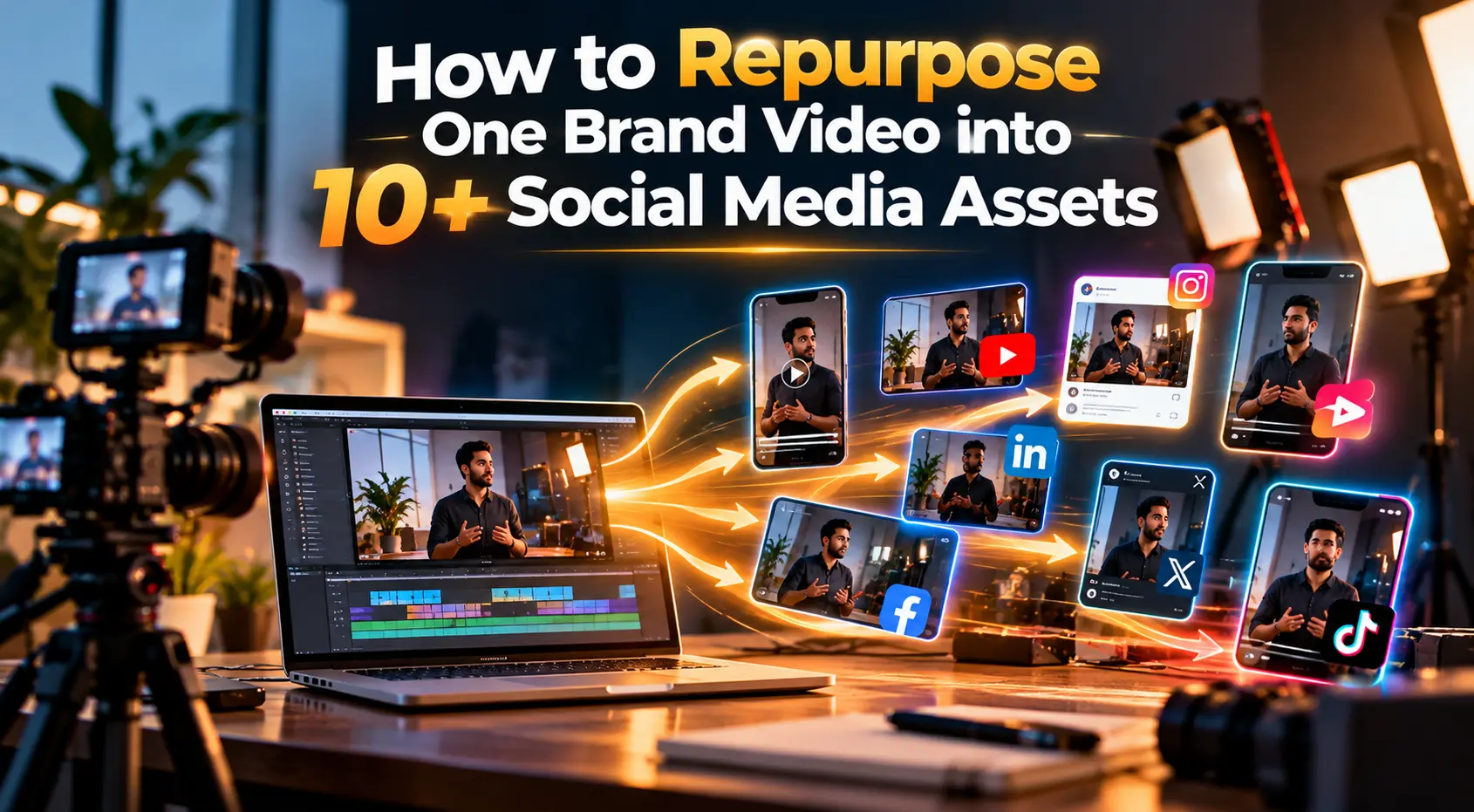
Video Content Repurposing
Creating a high-quality brand video requires strategy, planning, production and post-production. But the value of that production does not have to end when the final video is delivered.
A single well-planned brand video can become the foundation for an entire library of Social Media Video Content.
Instead of treating one production as one finished video, brands can extract multiple stories, quotes, product features, educational moments and promotional clips from the same project.
This approach is known as Video Content Repurposing.
For businesses, the benefit is simple: one production can potentially generate many content assets for different platforms, audiences and marketing objectives.
The exact number of assets will depend on the original video’s concept, footage, interviews and production scope, but a strategically planned shoot can create substantially more content than a single hero video.
What Is Video Content Repurposing?
Video content repurposing is the process of transforming an existing video or video shoot into multiple content formats for different platforms, audiences and marketing objectives.
A long-form brand video can be edited into short-form videos, social media clips, educational content, customer quotes, founder messages, product features, advertisements and behind-the-scenes content.
For example:
Rather than starting from zero every time the marketing team needs a new video, existing footage becomes a reusable content resource.
Why Video Repurposing Matters
The demand for video content continues to increase across digital marketing.
Producing every piece of content independently can require significant time and resources.
Video Content Repurposing provides an alternative. A single production can be designed with multiple outputs in mind.
One production can provide multiple pieces of content instead of a single finished video.
Maintain Brand Consistency
Different content pieces can use the same visual language, messaging and production style.
Extend the Life of a Video
A hero video can continue generating content weeks or months after its original release.
Improve Production Efficiency
The same shoot can support multiple marketing requirements.
Create Platform-Specific Content
The original footage can be adapted for different aspect ratios, lengths and audience behaviors.
Start With One Hero Video
The foundation of a repurposing strategy should be a hero video.
The hero video contains the primary story. During production, however, the team should identify additional stories that can be extracted later.
For example, a corporate video could contain:
How to Repurpose One Brand Video Into 10+ Assets
Here is a practical framework for turning one production into multiple social media assets.
1. Full YouTube Video
The complete hero video can become the main long-form content asset.
Depending on the project, this could be a:
YouTube can serve as the central repository for the long-form version.
2. LinkedIn Video
Create a shorter version specifically for LinkedIn.
The edit can focus on:
The opening should quickly communicate why the content is relevant to a professional audience.
3. Instagram Reel
Extract the most visually compelling or emotionally engaging section and turn it into a vertical Reel.
The objective is to make the first few seconds meaningful enough to encourage viewers to continue watching.
4. YouTube Short
A separate short-form edit can be created for YouTube Shorts.
The same source footage can be used, but the edit should be optimized for vertical viewing and short attention spans. A single strong statement, product benefit or customer insight can become the central idea.
5. A Second Reel With a Different Hook
One story can support multiple introductions.
For example, the same interview could be edited around:
This creates multiple content pieces without requiring another shoot.
6. Customer Quote Clip
If the hero video includes a customer or testimonial, identify memorable statements and turn them into short clips.
For example:
These clips can become valuable social proof. Add subtitles and simple branding while allowing the customer’s own voice to remain the focus.
7. Founder Quote Video
Founder interviews can provide numerous short-form content opportunities.
Extract statements about:
Each meaningful statement can potentially become its own piece of Brand Video Content.
8. Behind-the-Scenes Video
The production itself can become content.
Capture:
Behind-the-scenes content can make a brand feel more human and provide audiences with a look at how the campaign was created.
9. Product Feature Clip
If the original shoot includes product footage, isolate individual features.
Create: “One feature that solves this problem.”
Multiple features can potentially become multiple short videos. This is especially useful for technology, consumer products, manufacturing and SaaS brands.
10. Educational Clip
Look for information in the hero video that can teach the audience something.
For example:
Educational content can help position a company as a useful source of information rather than only a promotional brand.
11. FAQ Video
Customer questions can become short videos.
If the hero video or interview answers questions such as:
Each answer can potentially become an individual FAQ video. This can also support search-oriented content strategies.
12. Animated Text-Based Clip
Not every social video needs to show a person speaking.
Important statements can be transformed into animated typography or motion graphics. For example:
The original video provides the insight, while animation creates a new visual format.
13. Story Format
Long-form footage can also be converted into Instagram or other story-friendly content.
Use short sequences such as:
Stories can also include polls, questions or other interactive elements when appropriate to the platform.
14. Paid Advertising Variation
The same production can provide material for paid campaigns.
Create different versions around:
Different creative variations can then be tested against relevant audiences.
How to Build a Content Pillar From One Video
Repurposing becomes more effective when the content is organized into content pillars.
Suppose a company produces one corporate brand film. The footage could be organized into:
These pillars can support an ongoing Video Content Strategy.
How AI Can Assist Video Repurposing
AI can accelerate several parts of the repurposing workflow.
AI can help identify and accelerate production opportunities, but decisions about story, context, accuracy, brand voice and creative quality require human judgment.
This is where AI Video Production can complement traditional video production workflows.
How to Adapt One Video for Different Platforms
One video should not simply be uploaded everywhere in exactly the same format.
Different platforms have different audience behaviors and technical requirements.
Focus on longer-form storytelling, education and detailed demonstrations.
Emphasize business insights, leadership, customer stories and industry relevance.
Prioritize visually engaging vertical content and concise storytelling.
YouTube Shorts
Focus on one clear idea, hook or takeaway.
Website
Use longer-form brand videos, product explainers and customer stories where visitors need deeper context.
Digital Advertising
Create concise versions with clear messaging and calls to action.
How to Build a Monthly Social Video Calendar From One Shoot
A major advantage of content repurposing is the ability to extend one production across an entire month.
For example:
| Week | Content |
|---|---|
| Week 1 | Hero video + Founder Reel |
| Week 1 | Product feature clip |
| Week 2 | Customer quote |
| Week 2 | Educational video |
| Week 2 | Behind-the-scenes Reel |
| Week 3 | FAQ video |
| Week 3 | Product demonstration |
| Week 3 | Industry insight |
| Week 4 | Customer story |
| Week 4 | Promotional video |
| Week 4 | Short educational clip |
The exact calendar should depend on the brand’s objectives and audience.
Don’t wait until after production to think about repurposing.
Plan the content ecosystem before the cameras start rolling.
How to Plan a Repurposing-Friendly Video Shoot
The best repurposing strategies begin during pre-production.
Instead of recording one generic interview, ask questions designed to produce independent content topics.
Shoot Plenty of B-Roll
Additional footage gives editors more flexibility when creating short-form content.
Capture Vertical Footage
Where appropriate, record vertical-friendly shots for social media.
Record Multiple Product Angles
Different product shots can support separate feature videos.
Capture Behind-the-Scenes Footage
Assign someone to document the production process.
Think in Content Chapters
Structure the shoot around themes that can later become independent clips.
This turns production from a single-video project into a content-generation system.
How Many Social Media Posts Can One Video Create?
There is no fixed number.
A strong production can potentially generate 10 or more content assets, particularly when interviews, demonstrations, product footage and behind-the-scenes material are captured strategically.
The important metric is not simply the number of clips. The objective is to create useful, differentiated content rather than producing multiple versions that all say the same thing.
What Is the Difference Between Repurposing and Reposting?
These terms are often confused.
Repurposing means transforming existing content into a different format, story, length or platform-specific asset.
For example:
Reposting: Uploading the same 90-second video to Instagram and LinkedIn.
Repurposing: Turning that 90-second video into a 20-second Reel, a customer quote clip, an educational video and a LinkedIn insight video.
Repurposing creates additional value from the original content.
Measuring the Success of a Video Repurposing Strategy
The right metrics depend on the objective.
For engagement: Watch time, Completion rate, Shares, Saves, Comments
For traffic: Click-through rate, Website visits, Landing-page sessions
For lead generation: Enquiries, Form submissions, Calls, Qualified leads
For advertising: Cost per result, Conversion rate, Return on ad spend where measurable
The goal should be to identify which content formats and topics are generating meaningful results and use those insights to improve future productions.
Common Video Repurposing Mistakes
Ignoring Platform Context: A LinkedIn video should not necessarily be identical to an Instagram Reel.
Cutting Without a Hook: Short-form content needs a clear reason for the viewer to continue watching.
Removing Context: A short clip should still make sense when viewed independently.
Overusing AI: Automation can accelerate production, but excessive automation can make content feel generic.
Not Capturing Enough B-Roll: Without supporting footage, short-form editing options become limited.
Waiting Until Post-Production: Repurposing should be planned during pre-production.
One Shoot Can Become a Complete Social Content Ecosystem
The traditional approach to video production is:
A content-first approach is:
This changes how brands think about production budgets. Instead of asking only: “What does one video cost?” Marketing teams can also ask: “How many useful content assets can this production generate?”
That shift can make video production a more integrated part of the overall content strategy.
Why Work With a Professional Social Media Video Production Partner?
Successful content repurposing requires more than cutting a long video into shorter pieces. A professional Social Media Video Production team can plan the original production around future content requirements.
The result is a video production designed to create a content ecosystem, not simply one finished film.
Final Thoughts
Video production should not have to end with one video file. A well-planned brand production can become the foundation for weeks or months of Social Media Video Content.
One hero video can potentially generate:
YouTube video + LinkedIn video + Instagram Reels + YouTube Shorts + customer clips + founder content + product features + educational videos + FAQs + behind-the-scenes content + advertising variations.
Create once. Plan strategically. Repurpose intelligently.
By combining professional production with thoughtful editing, platform-specific storytelling and AI-assisted workflows, brands can turn one production into a much broader content strategy.
Turn One Production Into a Complete Social Content Ecosystem
Turn one production into a complete social content ecosystem with Ambest Brandcom.
Ambest Brandcom helps businesses plan and produce Brand Video Content, Social Media Video Content, Short Form Video Content and Product Marketing Videos that can be adapted across digital channels.
From concept and production to editing, AI-assisted repurposing and platform-specific variations, the goal is to help brands extract more value from every production.
Frequently Asked Questions About Video Content Repurposing
Video content repurposing is the process of transforming an existing video or video shoot into multiple content formats for different platforms, audiences and marketing objectives. One long-form video can become shorter clips, Reels, Shorts, educational videos, advertisements and other assets.
Start with a hero video and identify different stories, quotes, insights, product features and educational moments within the footage. These can then be edited into platform-specific videos with different lengths, hooks, formats and calls to action.
There is no fixed number. Depending on the footage and production scope, one strategically planned brand video can potentially produce 10 or more content assets. The quality and uniqueness of each asset are more important than simply increasing the number of clips.
Businesses can create more video content by planning productions around multiple deliverables, capturing interviews and B-roll strategically, repurposing existing footage, creating platform-specific edits and using AI-assisted tools to accelerate repetitive production tasks.
Reposting means publishing the same content again, while repurposing means transforming existing content into a new format, length, story or platform-specific asset.
Yes. AI can assist with transcription, clip identification, captions, subtitles, audio cleanup, resizing, localization and other repetitive tasks. Human creative review remains important for storytelling, context, accuracy and brand consistency.
Yes. A brand video can be adapted for YouTube, LinkedIn, Instagram, Shorts and digital advertising. However, each version should be edited according to the platform, audience behavior, aspect ratio and communication objective.
A brand video can be divided into content pillars such as brand, product, people, education and customer proof. Individual clips from each pillar can then be scheduled throughout the month across relevant social platforms.
Repurposing can improve production efficiency because multiple assets are developed from existing footage. However, the overall cost depends on the original production scope, editing requirements, number of deliverables and complexity of each adaptation.
Planning before production allows the team to capture the interviews, B-roll, product shots, vertical footage and other material needed for future content. This creates more repurposing opportunities than trying to find additional content after the shoot has finished.
🚀 Let’s build videos that don’t just look good – but drive results.
Contact us today to get a customized video strategy for your business.
Call: +91 91525 13159 or Email: sachin@ambestbrandcom.in