
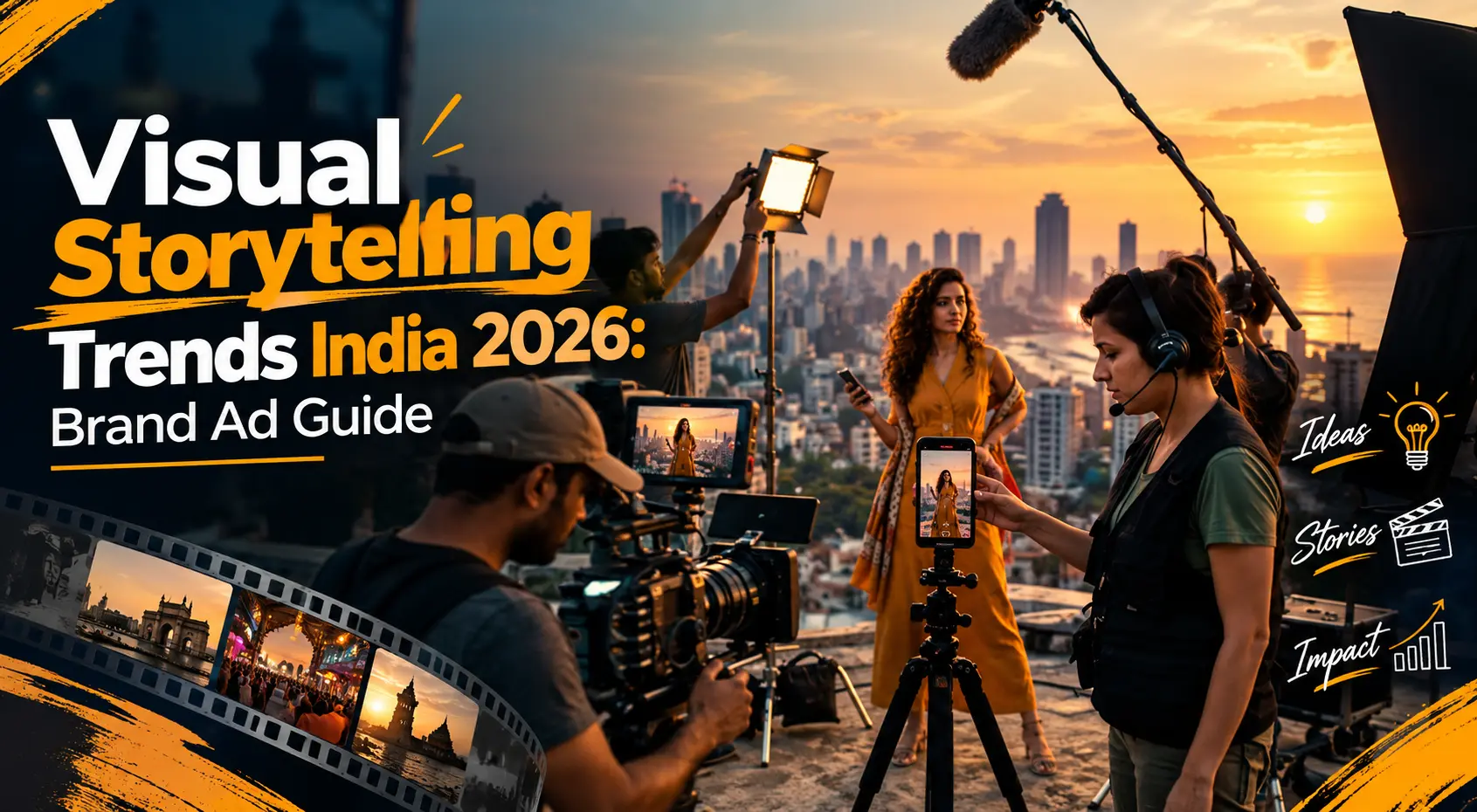
So, what are the latest trends in visual storytelling for brand advertising in India in 2026? Visual storytelling in this context means using compelling imagery, video, and narrative structure to communicate a brand message in a way that resonates emotionally and drives action. The answer sits at the intersection of a booming digital economy and a culturally diverse audience that demands more from every frame.
The Evolving Landscape of Visual Storytelling in India (2026)
Rs. 56,400 Cr
India’s digital advertising spend projected for FY2026.
46%
Command of total ad spend, per Ipsos State of Digital Marketing India 2025-26 report.
78%
Mobile platforms account for 78% of that digital spend.
According to DataReportal/Kepios, India’s internet user base stood at 806 million at the start of 2025 (January 2025), having grown by 49 million from January 2024; by end of 2025, the base reached 958 million (IAMAI-KANTAR) or 1.03 billion (DataReportal).
Scale & Regional Complexity
These numbers carry a concrete implication for brand teams: scale, regional complexity, and platform behavior should reshape how you brief and produce visual content. India’s cultural diversity, with 22 official languages and distinct regional traditions, makes visual storytelling here uniquely complex.
Emerging Visual Trends
The trends shaping 2026 span short-form video dominance, AI-powered production, vernacular narratives, creator-led content, and phygital experiences that blur the line between content and commerce.
The Dominance of Short-Form & Vertical Video
The traditional 30-second TV spot is giving way to 15-second Reels and YouTube Shorts. This shift demands what industry insiders call “narrative compression”: the hook, the attention-capturing moment, must land within the first 2 seconds, while the broader storytelling arc, conflict, resolution, and call-to-action, unfolds across the full 15-second format.
Short-form video ranks as the number one ROI format for the third consecutive year in 2026. Globally, 57% of marketing budgets now include a dedicated short-form line item, and Indian brands are catching up fast. The key is platform-native production: building vertical-first content from the script stage rather than retrofitting horizontal films for mobile screens.
Mute-friendly content is equally critical. Text overlays, captions, and visual-first storytelling significantly improve comprehension when sound is off. The 60 to 90 second brand film is also making a genuine comeback, not as a TVC substitute but as a standalone digital asset that gives brands room to build emotional depth. Our social media video production services are built around exactly this kind of platform-native storytelling.
AI-Powered Visual Production & Hyper-Personalization
AI is reshaping how visual content gets made in India. From AI-generated brand films to automated editing and AI-assisted animation, production timelines are compressing without sacrificing creative quality.
Animation & VFX Expansion
India’s animation and VFX sector is projected to grow from USD 1.3 billion to USD 2.2 billion by 2026, according to a CII-GT report. Brands are a significant part of that growth, using animation to visualize products that don’t physically exist yet or tell stories that would require feature-film budgets in live action.
Audience Targeting & Compliance
Hyper-personalization at scale is the promise: AI tools can generate multiple visual variations tailored to different audience segments, languages, and platforms. But with this power comes responsibility. The MeitY Amendment Rules 2026 reportedly introduce compliance considerations around AI content labeling and deepfake regulation that brands must navigate carefully.
Human Strategic Thinking Meets Technology
The brands winning with AI understand a simple truth: technology accelerates production, but human strategic thinking improves the likelihood that the narrative resonates. At Ambest Brandcom, our tech-based, scientific approach to creativity means we use AI to amplify, not replace, the creative direction that makes a story land. Our AI video production capabilities reflect this balance.
Hyper-Localization & Vernacular Narratives (‘Bharat-First’)
Over 73% of India’s internet subscribers consume content in regional languages, representing a $53 billion market opportunity. According to the Kantar-IAMAI ICUBE 2024 report, 870 million Indic-language internet users accessed the internet in 2024, representing 98% of total users; the earlier 540 million figure traces back to a Google-KPMG 2017 forecast for Indian-language users by 2021.
Here’s the catch: simply translating a Hindi script into Tamil doesn’t work. Each language carries distinct cultural codes, humor styles, and emotional triggers that must be understood from the conceptualization stage. Authentic localization means crafting narratives with context-specific references, not just swapping dialogue.
Brands are now creating content in Bhojpuri, Gujarati, Marathi, and other micro-regional languages to connect with highly specific audience segments. These languages often offer lower competition and higher engagement rates than mainstream campaigns. The brands serious about India are building multilingual video libraries, not just dubbing English content. Tier-2 and Tier-3 cities are driving incremental growth in video consumption, and a Hindi video does not serve Tamil Nadu.
Authenticity, Purpose-Driven Storytelling & Trust
India is stepping into what industry insiders call “the real-face era.” Polished corporate perfection is losing its shine. People want real voices, real faces, and real energy.
Stylized Reality & Value Alignment
ListenFirst found that the best-performing content “didn’t look like a campaign, it looked like life, stylized.” The four core emotional registers driving this shift are comfort, humor, connection, and identity. Consumers seek brands aligned with their values, demonstrating transparency and inclusive representation.
The Decisive Brand Window
The 6.5-second figure specifically refers to Gen Z’s average attention per social media post generally, not to all audiences or to brand advertising contexts. For brand advertising, the windows are shorter: Adobe’s 2026 report says brands have 5 seconds or less, Meta’s 2023 study found Gen Z ad attention as low as 1.3 seconds, and India-specific sources cite 2.5 to 3 seconds as the decisive window. That trust gap is why UGC aesthetics are bleeding into professional production, with brands intentionally incorporating authentic, unfiltered moments into commercial work.
Brands don’t win by looking flawless. They win by feeling human.
Creator-Led Content & The Micro-Influencer Ecosystem
The creator economy has formalized. Micro-creators now play a central role in brand advertising, producing visual stories that feel organic rather than overtly promotional.
Brands are moving from storytelling to “storyliving”: creating experiences where audiences participate rather than just watch. UGC aesthetics bleed into professional production, and behind-the-scenes content, founder interviews, and process documentation have become high-ROI categories. The strategic pivot is clear: reframe creator strategy as your trust strategy. Creator partnerships should be briefed with the same rigor as any production, with clear disclosure and measurement frameworks that track trust, not just reach.
Interactive, Shoppable & Immersive Experiences (Phygital)
The line between content and conversion is disappearing. Every ad is now performance-driven.
+50% Jump
Forecasted from Rs. 4,000 Cr to Rs. 6,000 Cr in 2026 (Madison World).
₹4.9K – 6K Cr
Ad revenue generated across quick commerce leaders like Blinkit, Zepto, and Swiggy Instamart.
₹30,360 Cr
Projected broader Indian retail media size in 2026, driven by Amazon and Flipkart.
Quick Commerce Advertising Scale
Quick commerce advertising is forecast to jump 50%, from Rs. 4,000 crore to Rs. 6,000 crore in 2026, according to Madison World’s AdEx Outlook 2026. Quick-commerce platforms like Blinkit, Zepto, and Swiggy Instamart generate roughly Rs. 4,900 to 6,000 crore in ad revenue or spend in 2026, a four-figure-crore figure.
The broader India retail media market, including Amazon and Flipkart, is projected at approximately Rs. 30,360 crore in 2026.
Immersive Senses & AR Interaction
Phygital experiences blend physical and digital interactions through AR, VR, and CGI. Adobe reports that 82% of global consumers expect their senses to be as engaged as possible, and interactive AR content is showing significant session time increases on platforms like Snapchat and Meta.
Case Studies: Brands Leading Visual Storytelling in India
Several Indian brands illustrate these trends across diverse sectors:
CRED
Surreal, AI-adjacent visual campaigns that blend humor with premium aesthetics, proving financial services advertising can be culturally cool.
Amul
Timeless topical visual storytelling that has maintained cultural relevance across decades through simple, timely, and emotionally resonant imagery.
Tanishq and Sabyasachi
Culturally rooted visual narratives celebrating Indian craftsmanship, heritage, and regional identity.
Zomato
Platform-native, short-form, humor-driven content strategy built for the scroll economy.
boAt and Mamaearth
Creator-led, UGC-influenced visual storytelling that leverages micro-influencer authenticity.
SBI Life and HDFC Mutual Fund
Purpose-driven emotional storytelling in financial services, connecting complex products to real-life moments.
Paper Boat
Nostalgia-driven visual narrative connecting regional Indian flavors with identity and memory.
Case Studies: Brands Leading Visual Storytelling in India
Several Indian brands illustrate these trends across diverse sectors:
CRED
Surreal, AI-adjacent visual campaigns that blend humor with premium aesthetics, proving financial services advertising can be culturally cool.
Amul
Timeless topical visual storytelling that has maintained cultural relevance across decades through simple, timely, and emotionally resonant imagery.
Tanishq and Sabyasachi
Culturally rooted visual narratives celebrating Indian craftsmanship, heritage, and regional identity.
Zomato
Platform-native, short-form, humor-driven content strategy built for the scroll economy.
boAt and Mamaearth
Creator-led, UGC-influenced visual storytelling that leverages micro-influencer authenticity.
SBI Life and HDFC Mutual Fund
Purpose-driven emotional storytelling in financial services, connecting complex products to real-life moments.
Paper Boat
Nostalgia-driven visual narrative connecting regional Indian flavors with identity and memory.
Frequently Asked Questions
Implications for Brands and Advertisers in India
The strategic takeaways are clear. Brands need agile content strategies, cross-platform synergy, and measurement metrics beyond traditional reach. Platform-native, vertical-first production must start at the script stage. Multilingual video libraries, not dubbed content, are the path to reaching Bharat. And the balance between AI efficiency and human cultural insight is non-negotiable.
73% of Indian brands increased video production budgets in 2026. Falling behind is a competitive risk, not just a missed opportunity. India’s advertising industry is projected to reach Rs. 1.4 lakh crore by 2027, and visual-first storytelling is no longer optional.
At Ambest Brandcom, we bring over 20 years of experience and 1800+ projects and campaigns to every brief. Our ability to produce 10x video variations per project means your story gets optimized across every channel, continuously. We combine strategic thinking before creative execution with AI-assisted workflows to simplify complex business messages into memorable moments.
Ready to turn your brand’s story into visual content that moves audiences and drives results? Partner with Ambest Brandcom for digital ad film production built for the 2026 landscape. Let’s build something memorable together.
🚀 Let’s build videos that don’t just look good – but drive results.
Contact us today to get a customized video strategy for your business.
Call: +91 91525 13159 or Email: sachin@ambestbrandcom.in