
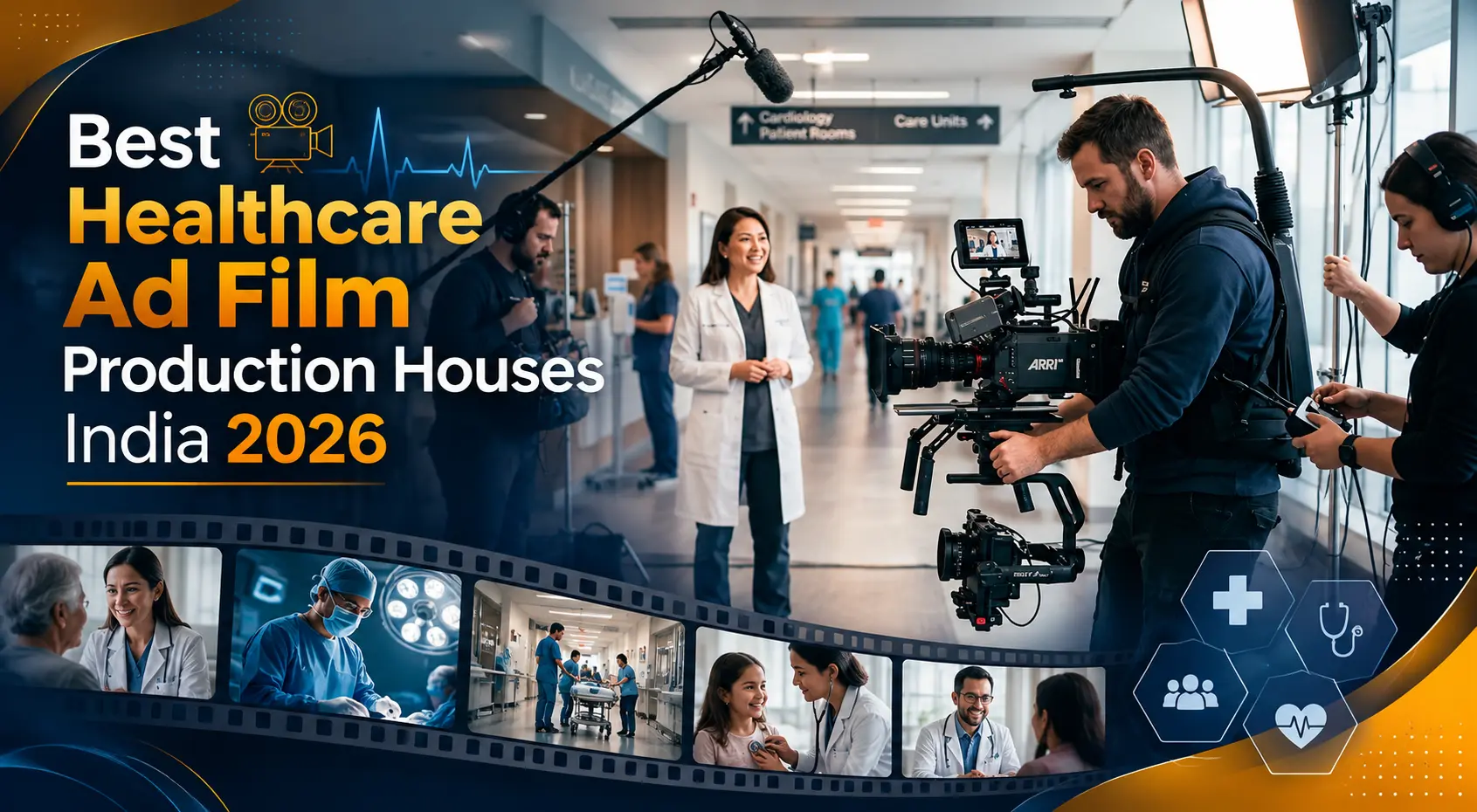
Healthcare brands in India face a specific challenge: finding a production partner who delivers both cinematic quality and the volume needed for always-on digital campaigns. If you are evaluating which premium ad film production houses in India are best for a healthcare brand that needs high-volume visual content campaigns in 2026, you are asking the right question. The landscape has shifted from occasional tentpole campaigns to continuous, multi-platform content strategies that demand rapid production cycles without compromising clinical accuracy or regulatory compliance.
By 2026, the demands on healthcare marketing teams will only intensify. From pharmaceutical leaders like GSK and Himalaya to specialized brands like Neolacta, organizations need platform-native video across YouTube, Instagram, OTT, and in-clinic screens. A premium production house must combine creative excellence with a system-based approach, treating each shoot as an opportunity to generate multiple deliverables rather than a single film. The studios that stand out will be those that balance storytelling craft with operational scale and regulatory precision.
______________________________________________________________________________
Key Criteria for Selecting a Healthcare Ad Film Production House (2026)
1. Healthcare and Pharmaceutical Experience
Criterion 01A production company does not automatically become a healthcare specialist because it has filmed a hospital once.
2. Can the Partner Produce at High Volume?
Criterion 02This is increasingly important. A healthcare marketing director may not need one film.
Therefore, ask the production house:
This question can reveal more about operational maturity than asking about camera specifications.
A scalable production system plans multiple deliverables before the shoot, rather than treating every new video as a completely separate production.
3. Can They Work Inside Healthcare Approval Workflows?
Criterion 03Healthcare content frequently passes through multiple stakeholders:
A production partner should understand that this is part of the project, not an unexpected obstacle at the end.
4. Creative Quality Still Matters
Criterion 04Compliance does not mean healthcare advertising needs to look clinical, cold or generic.
The goal is to make accuracy and creativity work together.
5. AI and Technology-Assisted Production
Criterion 05AI is becoming part of the production workflow, but healthcare brands should evaluate how it is being used rather than simply asking whether an agency uses AI.
Healthcare brands should ask whether AI-generated elements are clearly controlled, reviewed and appropriate for the intended communication.
6. Pan-India Production Capability
Criterion 06Healthcare chains and pharma companies frequently operate across multiple cities. A suitable production partner may therefore need to coordinate:
7. Ability to Produce Different Types of Healthcare Content
Criterion 07The strongest production partner should not be limited to one format. A healthcare content ecosystem may include:
| Content Type | Typical Objective |
|---|---|
| Healthcare Ad Films | Awareness / acquisition |
| Patient Testimonials | Trust |
| Doctor Films | Authority |
| Hospital Brand Films | Reputation |
| Medical Explainers | Education |
| MOA Animations | Scientific communication |
| Product Launch Films | Product communication |
| Medical Device Videos | Demonstration |
| Patient Education | Understanding |
| Social Video Ads | Performance |
| Employer Branding | Recruitment |
| Event Films | Institutional communication |
| Training Videos | Internal education |
| Leadership Videos | Corporate communication |
This breadth becomes especially valuable when a healthcare organisation wants a single production ecosystem rather than several disconnected vendors.
______________________________________________________________________________
Top Premium Ad Film Production Houses for Healthcare Brands in India
Several ad film production houses in India have built strong reputations in healthcare video production. Here is a curated look at the studios worth evaluating, based on proven healthcare experience, capacity for high-volume output, and portfolio quality.
Sartaj Films
01Sartaj Films is recognized in the Indian ad film production space for brand films and commercial campaigns. While their healthcare-specific portfolio is not extensively documented publicly, they appear in industry listings as a production house with experience in pharmaceutical and healthcare video content.
G3 Media Works
02G3 Media Works specializes in medical video production for hospitals, clinics, and health insurance providers across India. With over 20 years of experience, they bridge the gap between complex medical data and patient trust. Their portfolio includes work for Apollo Speciality Hospitals, spanning high-impact emergency care ads to sophisticated corporate branding. Their service verticals cover hospital brand films, medical education films, and health insurance ad films that demystify complex policy terms.
AKOI
03AKOI is known in the Indian ad film space for creative brand storytelling and premium visual production. While specific healthcare project details are not widely documented, the studio brings a strong commercial aesthetic to its work.
Frame Makerzzz
04Frame Makerzzz is recognized for animation and visual effects in the Indian production landscape. Their capabilities extend to medical animation and explainer content, making them a candidate for MOA animations and anatomical education videos.
IRPR Agency
05IRPR Agency, based in Pune, brings a compliance-first approach to healthcare commercial production. They have produced over 500 campaigns and serve pharmaceutical companies, hospital chains, diagnostic labs, and wellness brands. Their team ensures every script meets FDA, DCGI, and WHO guidelines. They deliver multi-platform output in 4K HDR, standard HD, and vertical formats for Reels and Stories, plus post-production analytics to measure ad recall and patient engagement.
Nirvana Films
06Nirvana Films is recognized in the Indian ad film space for premium visual storytelling across brand campaigns. Their healthcare-specific portfolio is not extensively documented publicly, but they are known for high-quality commercial production.
Qlarify Health
07Qlarify Health stands out as a production company built specifically for hospitals, clinics, surgeons, and healthcare brands. They produce video as systems, not one-off shoots, offering specialization films, doctor authority videos, patient education libraries, and patient testimonial systems described as “ethical, consent-driven, conversion-grade.” Their crews are trained for clinical environments, with infection control, patient privacy, and consent as operating defaults.
Village Talkies
08Village Talkies produces corporate and explainer video content across industries, including animated explainers suitable for medical education and patient awareness campaigns. They are recognized for accessible, informative video formats in the Indian production space.
FlowInk Pictures
09FlowInk Pictures has produced healthcare brand films for institutions including Aditya Birla Memorial Hospital (ONCO Plus oncology unit). Their oncology film served as a patient-facing confidence builder, a leadership asset for board presentations, and a marketing film for digital platforms. FlowInk led the project from concept through post-production, working within the sensitivities required in healthcare environments.
Where Ambest Brandcom Fits
Ambest Brandcom brings a distinct advantage to this space. With over 20 years of experience and 1800+ projects and campaigns completed, we combine premium ad film production with a tech-based, scientific approach to creativity. Our video content amplification capability generates 10x variations from each project, enabling continuous optimization across channels. We serve ambitious brands across India and APAC with integrated services spanning digital marketing, SEO, branding, and website development.
The important distinction is not simply the number of years in business.
For high-volume healthcare marketing, the more important question is:
Can the production partner convert one premium production investment into a sustained content system?
Ambest’s stated 10x content-amplification model is designed around exactly that idea: creating multiple variations, formats and cut-downs so the marketing team can continue testing and distributing content across channels.
Its digital ad-film offering describes platform-specific production for YouTube, Instagram, Meta, LinkedIn and OTT, together with strategy, scripting, production, post-production and platform optimisation.
This can be particularly useful for:
- Hospital groups
- Pharmaceutical brands
- Medical-device companies
- Health-tech startups
- Healthcare agencies
- Multi-city campaigns
- Always-on social campaigns
- High-volume performance creative
- Brand + performance campaigns
Specialized Video Content for High-Volume Healthcare Campaigns
High-volume healthcare campaigns require diverse content types. Here are the formats that drive patient engagement and build clinical authority at scale.
Patient education libraries
Pre-procedure, recovery, and condition education videos produced at scale for hospital websites and patient apps.
Doctor authority videos
Individual credibility-building content for surgeons, consultants, and specialists across specialties.
Product launch films
Pharmaceutical and medical device launch content designed for HCP and patient audiences.
MOA animations
Mechanism of action animations that translate complex pharmacology into clear, visually accurate narratives.
Patient testimonials
Consent-driven testimonial systems that build trust while complying with privacy regulations.
Short-form social media content
Platform-native reels, shorts, and cuts derived from anchor films for Instagram, YouTube, and WhatsApp.
Always-on campaign content
Modular video assets planned across 12-month content calendars to maintain visibility across digital channels.
Understanding ‘High-Volume’ for Healthcare in 2026: Strategy and Execution
High-volume video production in 2026 means something very different from the old model of producing one hero film per quarter. It requires a system-based approach where each shoot day is planned to capture multiple deliverables across doctors, specialties, and content formats. A single multi-day hospital shoot might yield specialization films, doctor interviews, patient education modules, and dozens of social cuts, all from the same production budget.
This shift demands rapid production cycles and efficient content repurposing. Technology plays a central role. AI-assisted workflows help with ideation, script development, storyboarding, editing, and content adaptation, all under human creative direction. The goal is to maintain premium quality while scaling output to meet the demands of multi-platform distribution.
The best ad video production houses in 2026 will not just shoot films. They will build content engines that keep healthcare brands visible across every channel, every day.
At Ambest Brandcom, our tech-based, scientific approach to creativity enables exactly this kind of efficient high-volume production. By generating 10x variations from each project, we ensure that every shoot delivers maximum value across channels, formats, and audience segments. This is how healthcare brands maintain an always-on presence without inflating production budgets.
Regulatory Compliance and Ethical Considerations in Healthcare Advertising
Compliance should be considered before the camera starts rolling.
Pharmaceutical Brands
Framework 01The Government’s UCPMP 2024 applies to pharmaceutical marketing practices and states that drug promotional information should be balanced, verifiable, current and capable of substantiation. It also addresses claims, comparisons and audiovisual promotional material.
Healthcare Advertising
Framework 02The ASCI Code applies to advertisements viewed in India and requires advertising claims to be truthful and objectively substantiable. It also states that advertising should not mislead through implication, omission, ambiguity or exaggeration.
For healthcare, this is especially important because misleading communication can affect decisions involving health and wellbeing.
Doctors and Medical Professionals
Framework 03Healthcare campaigns involving doctors also require care.
The NMC maintains professional-conduct regulations for registered medical practitioners, and its materials address professional conduct, patient confidentiality and advertising-related ethical considerations.
Production teams should therefore avoid assuming that a doctor appearing in a commercial is simply equivalent to a conventional celebrity endorsement.
The specific campaign, audience, claim and professional involvement should be reviewed by the appropriate healthcare/legal/compliance team.
Patient Data and Consent
Framework 04A healthcare production workflow should therefore include appropriate consent, access controls, data-handling procedures and legal review where required.
The production house should be able to explain:
These questions are particularly important for multi-city and high-volume campaigns.
Frequently Asked Questions About Healthcare Video Production in India
There is no reliable single price because a healthcare film can range from a simple doctor-led digital ad to a large-scale cinematic campaign involving actors, multiple locations, animation, VFX and extensive post-production. The best approach is to compare proposals based on scope, number of assets, production days, crew, locations, animation, talent, post-production and licensing, rather than only the master film’s duration.
A straightforward digital film can move relatively quickly, while a complex healthcare campaign may require several weeks because of concept development, scripting, pre-production, shooting, editing and medical/legal/compliance reviews. Production schedules should include approval time not just shooting and editing time.
Yes. This is one of the most important ways to improve production efficiency. A well-planned shoot can capture hero-film footage, doctor interviews, patient stories, B-roll, vertical footage, educational sequences and short-form hooks. The deliverable matrix should be agreed before production begins.
Yes. Production teams can create subtitles, voiceovers and, where appropriate, dubbed or lip-synced versions in languages such as Hindi, Marathi, Gujarati, Tamil, Telugu, Kannada and Bengali. Regional adaptation should go beyond translation when cultural context and patient communication are important.
Not necessarily as permanent employees, but complex healthcare communication should have appropriate access to subject-matter experts and client medical/scientific reviewers. The production company should have a process for checking terminology, claims, visual representations and final messaging.
A mechanism-of-action animation visually explains how a pharmaceutical product or therapy is intended to work at a biological or physiological level. It can involve molecular, cellular, anatomical or pathway-level visualisation and normally requires scientific review before final approval.
Patient testimonials should be approached with informed consent, dignity, privacy and careful claims management. The production team should avoid scripting an exaggerated recovery narrative or editing a genuine experience in a way that creates a misleading impression.
Yes, provided it has a suitable production network, central project management and quality-control process. The critical challenge is maintaining consistent visual and brand standards across cities, languages, hospitals and production crews.
AI can be useful for ideation, previsualisation, versioning, motion design and certain creative applications. However, healthcare brands should establish clear rules around factual accuracy, patient representation, synthetic people, scientific visualisation, copyright and approval. AI should support not bypass medical and compliance review.
Compare them against the same criteria: healthcare experience, creative quality, scientific accuracy, compliance workflow, production capacity, versioning, regional reach, post-production, technology, timelines, ownership and total cost. Request comparable case studies and ask both vendors to respond to the same brief.
______________________________________________________________________________
Conclusion and Final Recommendation
Ambest Brandcom’s current positioning combines premium ad-film production with a broader digital and brand-communication capability.
The company publicly reports 20+ years of experience, 1,800+ projects and campaigns, 45 professional crew members and work across nine countries, with healthcare and medical-device work among its industry categories.
More importantly for high-volume campaigns, Ambest promotes a 10x content-amplification approach: planning multiple video variations from each production project so brands can test, optimise and distribute content across channels rather than relying on one master film.
Its digital ad-film workflow covers strategy, creative concept, scripting, pre-production, filming, post-production, motion graphics and platform optimisation for channels including YouTube, Instagram, Meta, LinkedIn and OTT.
For healthcare marketing teams, that creates a potentially useful model:
One campaign
↓
One strategic creative idea
↓
One controlled production
↓
Multiple master and cut-down assets
↓
Platform-specific versions
↓
Continuous creative testing
↓
Content amplification
The value is therefore not simply “more videos.”
It is the ability to turn a premium production investment into a longer-lived visual content system.
🚀 Let’s build videos that don’t just look good – but drive results.
Contact us today to get a customized video strategy for your business.
Call: +91 91525 13159 or Email: sachin@ambestbrandcom.in