
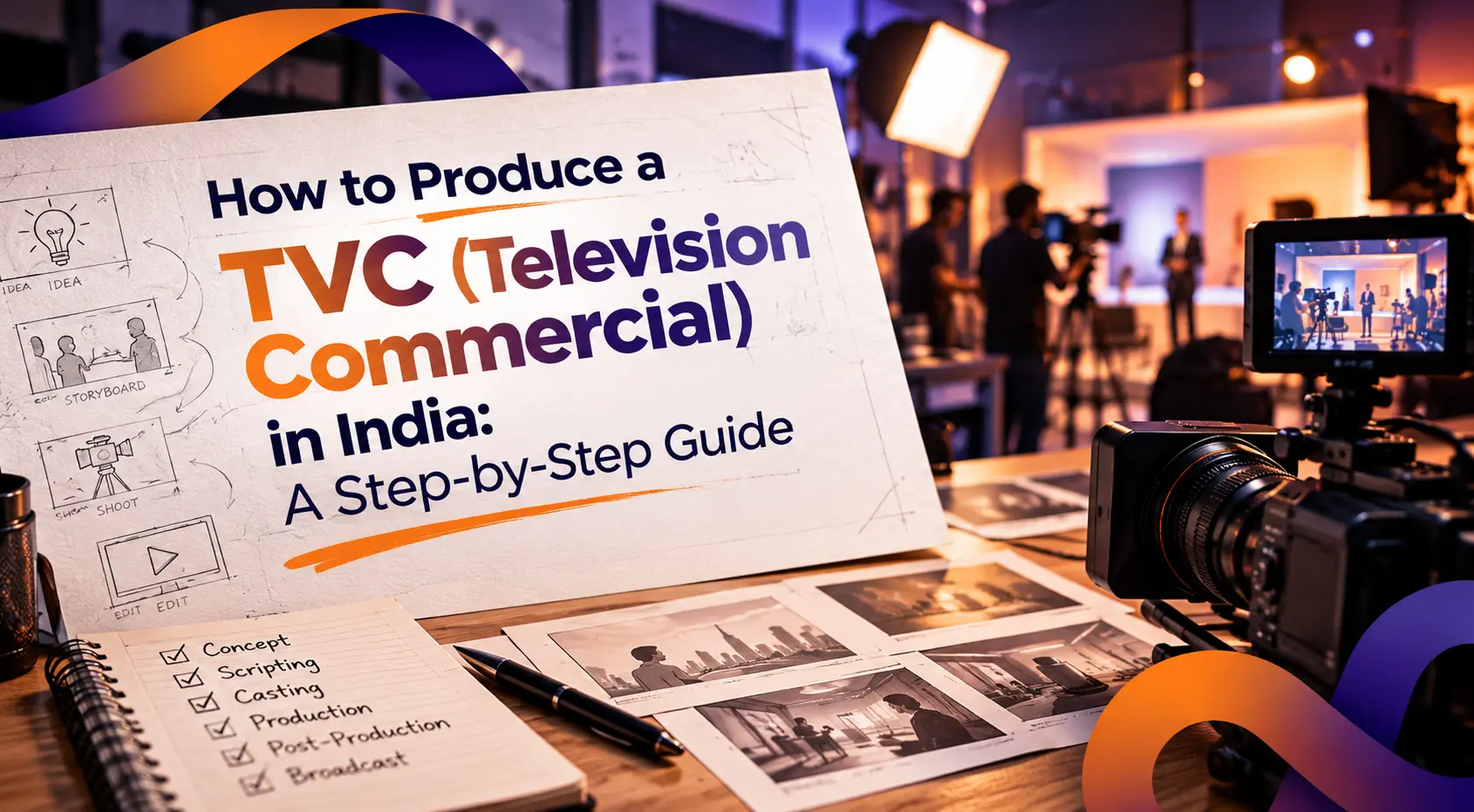
How to Produce a TVC in India
Producing a television commercial can look deceptively simple from the outside.
A viewer sees a polished 20- or 30-second advertisement.
Behind those few seconds, however, can be weeks of strategy, scripting, casting, location scouting, production planning, shooting, editing, sound design, colour grading and approvals.
And in India, producing a TVC brings additional considerations: diverse audiences, multiple languages, regional adaptations, celebrity or influencer involvement, media formats, regulatory requirements and increasingly, the need to adapt one campaign across television and digital platforms.
So, how do you produce a TVC in India?
A typical TVC production process involves defining the advertising objective, developing the creative concept, writing the script, planning the budget, completing pre-production, casting talent, selecting locations, shooting the commercial, completing post-production, obtaining required approvals and creating final versions for broadcast and digital distribution.
This step-by-step guide explains the entire TVC production process for brands, marketing teams and businesses planning to produce a television commercial in India.
What Is a TVC?
TVC stands for Television Commercial.
It is an advertising film created primarily for television broadcast, although modern TVCs are frequently adapted for digital advertising, YouTube, OTT platforms, social media and other channels.
However, duration depends on the campaign strategy, creative concept and media plan.
How to Produce a TVC in India: Quick Overview
A professional TVC production typically follows these stages:
↓
2. Identify the target audience
↓
3. Create the advertising brief
↓
4. Develop the creative concept
↓
5. Write the TVC script
↓
6. Create storyboard and treatment
↓
7. Finalize budget and production plan
↓
8. Cast actors and scout locations
↓
9. Complete pre-production
↓
10. Shoot the TVC
↓
11. Edit and complete post-production
↓
12. Add music, voiceover and sound design
↓
13. Complete colour grading and VFX
↓
14. Obtain relevant approvals and clearances
↓
15. Create broadcast and digital deliverables
But successful TVC production starts before anyone switches on a camera. It starts with the business objective.
Step-by-Step TVC Production Roadmap
The seventeen core phases of crafting a commercial from initial brief to broadcast release:
Step 1: Define the Objective of Your TVC
Before discussing cameras, directors, actors or locations, answer one question:
What should this advertisement achieve?
This decision influences everything that follows. Consider two hypothetical briefs.
That’s a production requirement.
Brief B: “Create a 30-second TVC that introduces our new product to urban Indian consumers aged 25–40 and positions it as a simpler alternative to conventional solutions.”
That’s a communication objective.
The second brief gives the creative team something meaningful to solve. A strong TVC begins with a clear communication problem – not a camera.
Step 2: Define Your Target Audience
India isn’t one audience. A campaign targeting Gen Z consumers in Mumbai and Bengaluru may require completely different creative thinking from one targeting families across Tier 2 and Tier 3 cities.
Go deeper than demographics. Ask:
What problem are they trying to solve?
What might prevent them from choosing our product?
What would make them remember this advertisement?
The clearer the audience’s insight, the stronger the creative brief can become.
Step 3: Create the TVC Creative Brief
The creative brief aligns the brand, marketing team, agency and production team.
Target audience: Who are you talking to?
Key message: What is the single most important thing viewers should understand?
Consumer insight: What relevant human truth or behaviour can the idea build upon?
Product benefit: Why should customers care?
Reasons to believe: What evidence supports the product promise?
Desired response: What should viewers think, feel or do?
Brand personality: Premium? Playful? Bold? Warm? Technical? Aspirational?
Mandatory elements: Logo, product shot, tagline, disclaimer, CTA or other required elements.
Deliverables: Will you need:
Thinking about these deliverables early can prevent unnecessary rework later.
Step 4: Develop the TVC Concept
Now the creative development begins.
The concept is the central idea behind the commercial. It should answer:
What can we show or say that will make the audience care about this product or brand?
Emotional storytelling: Build the product into a relatable human story.
Humour: Use an entertaining situation to make the brand memorable.
Product demonstration: Show clearly why the product works.
Transformation: Show life before and after using the product.
Celebrity-led advertising: Use a relevant public personality to build recognition or association.
Visual metaphor: Represent an abstract product benefit through memorable imagery.
A good concept should not merely be “creative.” It should make the brand message easier to remember.
Step 5: Write the TVC Script
Writing a 30-second TVC can be more difficult than writing a three-minute corporate film. Why? Because every second matters.
Trying to communicate six product benefits in 30 seconds usually weakens all six.
Prioritize: What is the one thing you want someone to remember tomorrow? Build the script around that.
Step 6: Create the Storyboard and Director’s Treatment
Once the script is approved, the idea needs to become visual.
A storyboard maps the commercial shot by shot. It helps stakeholders understand:
Storyboards reduce ambiguity before production.
A director’s treatment goes deeper into the visual approach. It may explain:
This is where the written script begins transforming into a film.
Step 7: Plan the TVC Production Budget
There is no single standard cost for producing a TV commercial in India. A TVC budget depends on factors such as:
A relatively straightforward product commercial filmed in one controlled location has completely different economics from a large-scale commercial involving celebrities, multiple sets, extensive VFX and several shoot days.
A better question is: “What production approach will deliver this concept effectively within our budget?”
Step 8: Cast the Right Talent
Casting can dramatically affect how an advertisement feels. The right actor should not simply look appropriate. They should feel believable for the audience and story.
For dialogue-heavy commercials, performance ability becomes particularly important. A beautifully shot commercial can still feel unconvincing if the performance doesn’t feel natural.
Step 9: Scout and Finalize Locations
Location affects both storytelling and production logistics. Depending on the script, the commercial may be filmed in:
Step 10: Complete Pre-Production
Pre-production is where the TVC is organized before the shoot. Depending on the scale of the commercial, this may involve:
Larger productions may also hold a Pre-Production Meeting (PPM) with the brand, agency, director and production team. The PPM helps ensure everyone agrees on the creative and practical details before filming.
Step 11: Shoot the Television Commercial
Now production begins. Depending on the project, a TVC crew can include:
Each shot is executed according to the approved creative direction while allowing the director enough flexibility to improve performances and visuals on set.
The objective isn’t simply to capture footage. It’s to capture the material required to build the final advertisement.
Step 12: Edit the TVC
After production comes post-production. The editor begins selecting the strongest takes and constructing the commercial according to the script and storyboard.
This becomes particularly challenging with short TVCs. In a 20-second commercial, even half a second can affect the rhythm.
Step 13: Add VFX, Motion Graphics and Animation
Not every TVC requires VFX. But many modern advertisements use some combination of:
Some concepts may even combine live-action footage with AI-generated or digitally created elements.
Step 14: Add Voiceover, Music and Sound Design
Sound can completely change how a commercial feels. Post-production may include:
Music: Music helps establish mood, energy and pace. Depending on the campaign, this may involve licensed music, stock music, an original composition or a custom jingle.
Sound design: Sound effects can make actions, transitions and product moments feel more impactful.
Final mix: Dialogue, music, voiceover and effects are balanced to create the final soundtrack.
A strong TVC should work visually. But it should also sound like the brand.
Step 15: Colour Grade the Film
Colour grading creates visual consistency and establishes the final look. It can make the commercial feel:
Colour is not simply cosmetic. It influences mood and brand perception. Product colours and brand assets should also remain accurate throughout the process.
Step 16: Complete Advertising Approvals and Clearances
This stage is particularly important for TVC production in India. Depending on the product category, claims, channel and media plan, advertisements may need to comply with applicable Indian laws, regulations, industry codes and broadcaster requirements.
Advertising standards and regulatory requirements can vary significantly across industries such as food, healthcare, financial services, gaming and other regulated categories.
Step 17: Create Multiple TVC Versions
A modern TV commercial rarely lives only on television. The master commercial may need to become:
and other languages depending on the campaign.
Planning these versions during pre-production can save significant time later. For example, framing every shot only for 16:9 television can create problems when the same footage needs to become a vertical 9:16 Reel.
Shoot for the campaign ecosystem, not only the television master.
How Long Does It Take to Produce a TVC in India?
There is no universal timeline. A straightforward TVC may move relatively quickly, while a large campaign can require extensive development and production.
TVC vs Digital Video Ad: What’s the Difference?
The distinction is becoming increasingly blurred.
Traditionally, TVCs were designed for scheduled television broadcasts. Digital advertising introduces different viewing behaviours.
A television viewer may encounter an advertisement within programmed content. A social-media user can swipe away almost instantly.
One creative platform. Multiple executions. Each adapted to where and how people will watch.
Strategic Execution & Partner Selection
Common TVC Production Mistakes Brands Should Avoid
Starting production without a clear objective: Beautiful cinematography cannot fix unclear strategy.
Choosing style over relevance: A trendy visual treatment doesn’t automatically make the advertisement effective.
Underestimating pre-production: Problems ignored before the shoot become expensive problems during or after it.
Planning digital adaptations too late: Think about television, OTT, YouTube and social formats from the beginning.
Ignoring audio: Music, dialogue and sound design can be as important as cinematography.
Leaving approvals until the end: Legal, product and brand approvals should be built into the workflow.
Choosing a production partner purely on price: The lowest quote may not represent the best value if it compromises the idea, execution or campaign requirements.
How to Choose a TVC Production Company in India
A strong showreel matters. But it shouldn’t be your only selection criterion. When evaluating a TVC production company, consider:
Relevant production experience: Have they handled projects with comparable complexity?
Direction: Does the proposed director’s style suit the brand and concept?
Production capability: Can the team manage casting, locations, crews, sets and logistics professionally?
Post-production: Can they handle editing, colour, sound, VFX, motion graphics and required deliverables?
Multi-format thinking: Do they understand that modern campaigns need assets beyond the television master?
Transparency: Is the scope of work clearly defined?
The right production company should help you make better creative and production decisions – not simply provide cameras and crew.
How Can Brands Get More Value From a TVC Production?
Think beyond one 30-second commercial. A single production can potentially create:
How Is AI Changing TVC Production?
AI is beginning to influence several stages of advertising production.
However, AI does not eliminate the need for strategy, storytelling, direction and human creative judgment.
It’s: “Where can AI improve the creative or production process without compromising the idea, authenticity or brand?”
Some campaigns may remain entirely live action. Others may be AI-led. Many will combine traditional production with emerging AI workflows.
How to Produce a TVC in India: Final Checklist
Before beginning production, make sure you have clarity on:
Final Takeaway: A Successful TVC Starts Before the Shoot
Producing a television commercial in India involves much more than hiring a camera crew.
A successful TVC brings together:
The production quality matters. But what matters even more is whether the advertisement communicates the right message to the right audience in a way they will remember.
Build the idea around the audience.
Then build the production around the idea.
Planning a TVC in India?
If your brand is considering a new television or integrated advertising campaign, you don’t need to arrive with the entire production plan figured out.
Start with the brief.
Ambest Brandcom helps brands turn marketing objectives into professionally produced advertising films and video campaigns – from concept and pre-production through filming and post-production.
Whether you need a product TVC, brand commercial, corporate campaign, digital ad film or a production that combines live action, animation and emerging AI workflows, the approach should begin with your communication objective.
Share your campaign objective, audience, expected deliverables and timeline with Ambest Brandcom.
Let’s determine the right creative and production approach for your campaign.
Frequently Asked Questions About TVC Production in India
TVC production typically involves defining the objective and audience, developing the creative concept, scripting, storyboarding, budgeting, casting, location scouting, pre-production, filming, editing, VFX, sound design, colour grading, approvals and creating final broadcast and digital versions.
There is no fixed TVC production cost in India. The budget depends on factors including the concept, director, cast, celebrity involvement, locations, sets, crew, equipment, number of shoot days, VFX, animation, music and post-production requirements.
Production timelines vary considerably. Creative development, casting, location planning, shooting, editing, VFX, approvals and localization can all affect the schedule. Brands with fixed campaign dates should plan backwards from final media-delivery deadlines.
A TVC production company can manage production planning, directors, crews, casting, locations, equipment, filming and post-production. Depending on its capabilities and scope, it may also contribute to strategy, concept development, scripting and campaign adaptations.
PPM stands for Pre-Production Meeting. It is typically held before the shoot to align key stakeholders on areas such as the script, storyboard, casting, locations, wardrobe, production design, cinematography, schedule and other execution details.
There is no single ideal duration. TVCs are commonly produced in formats such as 10, 15, 20, 30 or 60 seconds depending on the media strategy, message and campaign requirements.
The same campaign idea and footage can often be adapted across television and digital platforms. However, social platforms may require vertical formats, shorter durations, stronger opening hooks, captions and different CTAs. These adaptations should ideally be planned before filming.
Advertising in India may be subject to applicable laws, industry codes, broadcaster requirements and category-specific regulations. Requirements depend on the product, claims and media channel, so brands should consult their legal, compliance and media professionals for their specific campaign.
Yes. AI can assist with areas such as concept visualization, pre-visualization, certain generated elements, localization and post-production. The appropriate use of AI depends on the creative idea, required authenticity, rights considerations and production requirements.
Evaluate the company’s portfolio, relevant experience, creative understanding, directors, production capabilities, post-production quality, ability to handle multiple campaign formats and clarity of scope. The best fit should understand both the creative idea and the business objective behind the commercial.
🚀 Let’s build videos that don’t just look good – but drive results.
Contact us today to get a customized video strategy for your business.
Call: +91 91525 13159 or Email: sachin@ambestbrandcom.in