
AI Video vs Traditional Video Production
Video production is changing faster than ever.
Until recently, creating a professional brand video usually meant scripts, cameras, locations, actors, lighting, production crews, editing suites and weeks of planning.
Today, AI can generate visuals, voices, animations, environments and even complete video sequences without a conventional shoot.
That creates an important question for brands:
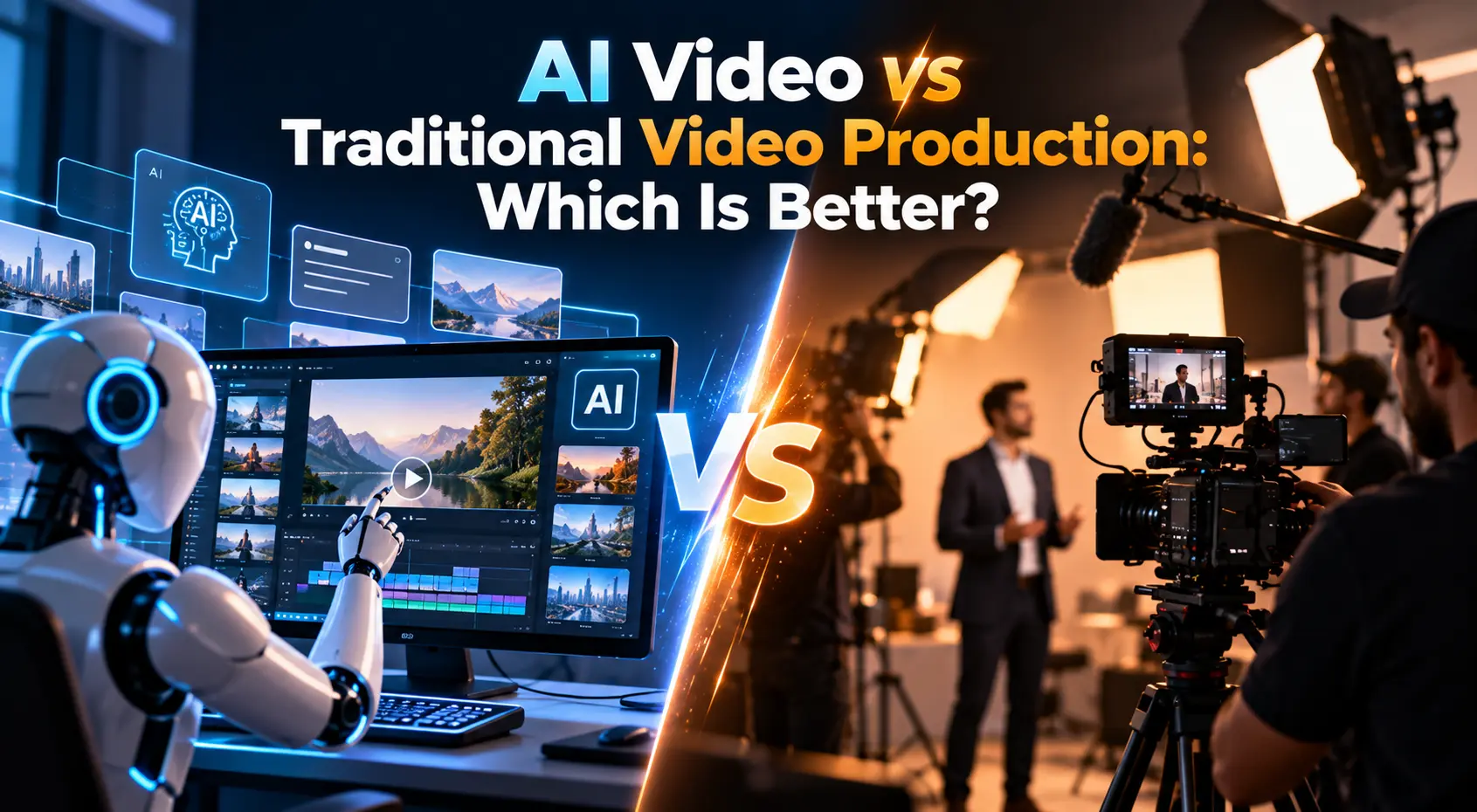
AI video vs traditional video production – which is better for your business?
The short answer is: neither is universally better.
AI video production is often better when speed, scalability, experimentation, localization or hard-to-film concepts are the priority. Traditional video production remains stronger when a brand needs real people, authentic environments, controlled performances and premium live-action storytelling.
And increasingly, the smartest option is a third one:
Hybrid video production – combining AI efficiency with human creativity and professional filmmaking.
Here’s how to decide which approach makes sense for your next video.
AI Video vs Traditional Video Production: Quick Answer
If you need a simple comparison:
| Factor | AI Video Production | Traditional Video Production |
|---|---|---|
| Production speed | Usually faster | Usually requires more planning |
| Scalability | Excellent | More resource-intensive |
| Multiple creative variations | Easier to produce | Often requires additional production/editing |
| Live human emotion | Limited | Excellent |
| Real locations | Can simulate them | Captures them authentically |
| Creative experimentation | Very high | High, but constrained by physical production |
| Localization | Easier to scale | Usually requires additional work |
| Cinematic live-action | Improving rapidly | Still a major strength |
| Product/brand authenticity | Depends on execution | Strong |
| Best for high-volume content | Yes | Depends on budget and schedule |
| Best for human-led brand stories | Sometimes | Yes |
| Best overall approach for many brands | Hybrid AI + human production | Hybrid AI + human production |
The real question, therefore, isn’t:
“Should we use AI or traditional video?”
It is:
“Which production approach will communicate our idea most effectively and deliver the best business outcome?”
What Is AI Video Production?
AI video production uses artificial intelligence during one or more stages of the video creation process.
This can dramatically change the economics and workflow of video production.
Imagine a brand wants to show its product being used in a futuristic city.
With traditional production, that concept could involve a studio, actors, sets, VFX artists and extensive post-production.
With an AI-assisted workflow, some of those environments or sequences may be generated digitally.
AI video production does not have to mean pressing a button and accepting whatever AI generates.
For professional brand communication, AI works best when it is guided by human strategy, storytelling, art direction, editing and brand judgment.
What Is Traditional Video Production?
Traditional video production is the established filmmaking process in which footage is physically captured using cameras, professional crews, real locations, sets, actors, employees, products or presenters.
Production: directors, cinematographers, cameras, lighting, sound recording, actors or presenters, sets and locations.
Post-production: editing, colour grading, sound design, music, motion graphics, animation, VFX and final delivery.
Traditional filmmaking gives creative teams a high degree of control over performances, products, physical environments and human interaction.
For brand films, corporate films, testimonials, leadership communication and emotionally driven advertising, that authenticity can be extremely valuable.
AI Video vs Traditional Video Production: The 7 Biggest Differences
1. Speed
Winner for most high-volume requirements: AI videoTraditional production requires coordination.
Locations must be finalized. People need to be available. Equipment must arrive. Shoots need to happen. Footage needs to be edited.
AI can remove or accelerate some of these stages.
A creative team may generate concepts, test visual directions and produce certain sequences without organizing a physical shoot.
However, “AI-generated” does not automatically mean “instant.”
High-quality AI videos can still require substantial creative direction, prompting, generation, refinement, compositing, editing and sound design.
AI makes production faster – but professional quality still requires craft.
2. Cost
Winner: It depends on the conceptOne of the biggest assumptions about AI video is:
“AI video is always cheaper.”
Not necessarily.
AI can reduce expenses associated with certain physical production requirements, such as locations, large crews, sets or repeated shoots.
But sophisticated AI production can still involve experienced creative professionals, premium AI tools, extensive generation cycles, animation, compositing, editing, sound design and quality control.
Traditional production costs also vary enormously.
A simple executive interview filmed at an office is completely different from a large advertising production involving multiple locations, actors and sets.
Ask: “Which approach gives us the strongest creative result for the available budget?”
That question leads to better marketing decisions.
3. Authenticity
Winner: Traditional videoIf your CEO needs to speak directly to employees, AI probably shouldn’t replace them.
If a customer is sharing a genuine success story, audiences should see the real customer.
If you’re showcasing your manufacturing facility, people may want to see the actual facility – not an AI interpretation of it.
Real people create something AI still struggles to reproduce perfectly:
genuine human presence.
When trust is central to the message, authentic footage can be incredibly powerful.
4. Creative Freedom
Winner: AI video for impossible concepts; traditional production for controlled realityWant your product floating above Mumbai?
Want to visualize a city in 2050?
Want to transform a factory into a futuristic digital ecosystem?
Want to explain an invisible scientific process?
AI can make previously impractical concepts far more accessible.
It allows creative teams to explore environments, characters and visual metaphors without physically building everything they imagine.
Traditional filmmaking, however, provides something equally important:
control over reality.
A director can adjust the lighting, move the camera, change an actor’s performance, reposition the product or reshoot a scene.
If the concept is difficult to physically film, AI may unlock it.
If precise real-world execution is essential, traditional production may be stronger.
5. Scalability
Winner: AI videoModern brands rarely need one video anymore.
This is where AI-assisted workflows become particularly valuable.
AI can help creative teams adapt, repurpose and localize content faster.
Instead of thinking about video as one finished asset, brands can start thinking in terms of a video content ecosystem.
6. Brand Consistency
Winner: Human-directed AI or traditional productionAI can generate beautiful visuals.
But beautiful doesn’t automatically mean on-brand.
Your brand has its own visual language, audience, tone, positioning and communication objectives.
Without strong creative direction, AI-generated content can become visually impressive but strategically forgettable.
Professional video production – AI or traditional – therefore needs human oversight.
What emotion should they feel?
Does this visual actually represent the brand?
Does the story support the business objective?
Would our customers believe this?
AI can generate content. Strategy determines whether that content means anything.
7. Human Emotion and Storytelling
Winner: HumansAI can help visualize a story.
It can accelerate production.
It can generate remarkable scenes.
But technology itself does not understand your customer the way an experienced strategist, writer or filmmaker can.
Powerful videos aren’t remembered simply because they look expensive.
They’re remembered because they make people feel something.
That is why the future of video production is unlikely to be simply “AI replacing filmmakers.”
When Should a Brand Choose AI Video Production?
AI video production can be an excellent option when your business needs:
Multiple campaign variations: Different hooks, visuals and CTAs can be tested without rebuilding every creative asset from scratch.
Hard-to-film concepts: AI can visualize futuristic, abstract, conceptual or imaginary environments that would otherwise require expensive production or VFX.
Multilingual content: AI-assisted workflows can help brands adapt content for multiple languages and markets.
Explainer and educational content: Complex ideas can be visualized through AI-generated graphics, environments and animation.
Faster experimentation: Instead of committing immediately to one direction, creative teams can explore multiple visual approaches before finalizing a campaign.
When Is Traditional Video Production Better?
Traditional production remains the stronger option when authenticity is fundamental to the message.
Consider traditional video production for:
Customer testimonials: Nothing replaces a genuine customer talking about their real experience.
Product demonstrations: When physical accuracy matters, filming the real product can be essential.
Factory and manufacturing films: Real facilities, processes and employees communicate scale and credibility.
Leadership videos: Executives speaking directly to customers, employees or investors can build stronger trust.
Premium advertising films: When performance, cinematography, production design and precise physical control matter, traditional filmmaking remains extremely powerful.
The Third Option: Hybrid Video Production
For many businesses, this may be the most interesting answer to the AI vs traditional video debate.
Don’t choose one. Combine them.
Imagine a corporate brand film.
You preserve authenticity where authenticity matters.
And use AI where AI creates an advantage.
That is hybrid video production.
It gives brands the human credibility of traditional filmmaking with the creative flexibility and scalability of AI.
AI Video vs Traditional Video: Which Is Better for Marketing ROI?
The production method alone does not determine ROI.
The best-performing production approach is therefore the one that supports your marketing objective.
For lead generation, you may need a strong problem-solution structure and CTA.
For corporate communication, credibility may matter most.
For paid social, you may need numerous creative variations to discover what performs.
Start with the business objective – not the technology.
How to Decide Between AI, Traditional and Hybrid Video Production
Before commissioning your next video, answer these seven questions:
1. What is the objective?
Awareness, engagement, leads, sales, education, recruitment or internal communication?
2. Who needs to appear?
Real customers, employees, founders or actors – or can the concept be generated visually?
3. How important is authenticity?
Would AI-generated imagery strengthen or weaken trust?
4. How many videos do you need?
One hero film or dozens of content variations?
5. How quickly do you need them?
6. Where will the videos be published?
Website, YouTube, LinkedIn, Instagram, advertising platforms, presentations or internal communication?
7. What does the idea actually require?
The answer to question seven often determines everything.
And don’t organize an expensive physical production if AI can execute the idea more intelligently.
Choose the technology around the creative idea – not the creative idea around the technology.
So, Will AI Replace Traditional Video Production?
Probably not.
It will change it.
Digital editing did not eliminate editors.
CGI did not eliminate physical production.
AI is becoming another powerful tool available to creative teams.
The companies likely to benefit most aren’t necessarily those producing the most AI content.
They will be the companies that understand when to use AI, when to film for real, and when to combine both.
AI Video vs Traditional Video Production: Final Verdict
So, which is better?
Choose traditional video production when authenticity, real people, physical environments, precise performances and cinematic live-action storytelling are essential.
Choose hybrid production when you want the strengths of both.
For many modern brands, hybrid production represents a powerful middle ground: human storytelling supported by AI-powered creative capabilities.
Because the future of video isn’t simply AI vs humans.
It’s about humans using AI intelligently to tell better stories.
Not Sure Whether Your Brand Needs AI or Traditional Video?
You shouldn’t have to choose a production method before you know what your idea actually needs.
Ambest Brandcom helps brands identify the right approach first – AI, traditional filmmaking or a combination of both and then builds the production around the business objective.
With 20+ years of creative and video production experience, Ambest Brandcom combines strategy, storytelling, professional production and emerging AI workflows to create videos designed to communicate, engage and drive action.
Whether you’re planning a brand film, corporate video, digital campaign, product video, AI-powered creative or a scalable video content strategy, start with the brief.
Tell us what you want your audience to think, feel or do.
We’ll help determine the smartest way to bring it to life.
Talk to Ambest Brandcom about your brief →
Get recommendations on the right production approach, creative direction and video format for your objective.
Frequently Asked Questions
AI video isn’t automatically better than traditional production. AI is particularly useful for speed, scalability, creative experimentation, localization and difficult-to-film concepts. Traditional video is generally stronger for authentic human performances, real locations and live-action storytelling. Many brands can benefit from combining both approaches.
AI can reduce some production requirements and make certain projects more cost-efficient, but pricing depends on complexity, quality, duration, creative requirements and the amount of professional editing involved. A simple traditional shoot may cost less than a complex AI production, so projects should be evaluated individually.
Production time depends on the concept and required quality. AI can accelerate several stages of video creation, but professional AI video production still requires creative development, generation, refinement, editing, sound design and quality control.
AI can automate or accelerate parts of production, but professional brand videos still require strategy, storytelling, creative direction, visual judgment and quality control. AI is most effective as part of a professionally managed creative workflow.
Hybrid video production combines traditionally filmed footage with AI-generated or AI-assisted content. A brand might film real employees, products or customers while using AI for conceptual scenes, visual effects, localization, creative variations or supporting environments.
Yes, where it adds genuine value. AI can be useful for visualizing abstract ideas, creating supporting graphics, localization, editing and content adaptation. However, real leadership, employee stories, testimonials and workplace footage may be preferable when authenticity and trust are important.
AI-assisted production can be particularly effective for social media because brands often need multiple formats, hooks, lengths and creative variations. However, authentic live-action content can also perform strongly. The right approach depends on the audience, platform and campaign objective.
Yes. Combining AI with traditional filmmaking allows brands to retain authentic human storytelling while gaining the speed, flexibility and creative possibilities of AI. This hybrid approach is increasingly useful for modern brand and marketing communication.
Start with your objective, audience, message, required level of authenticity, number of deliverables, timeline and budget. A professional video production partner can then recommend whether AI, traditional or hybrid production is best suited to the project.
Ambest Brandcom is a Mumbai-based video production company offering professional video production alongside AI-enabled creative workflows. Brands can work with the team on traditional, AI-assisted or hybrid video projects depending on their communication objectives.
🚀 Let’s build videos that don’t just look good – but drive results.
Contact us today to get a customized video strategy for your business.
Call: +91 91525 13159 or Email: sachin@ambestbrandcom.in