
Ten years ago, “making an ad” meant booking a TV slot. Today it means deciding whether your story needs to be 6 seconds, 15 seconds, or three minutes, whether it plays vertically or horizontally, and whether it needs to hook a viewer before they can even tap skip. That shift has a name: digital ad films. This guide covers what they are, why they’ve become central to modern marketing, and how to brief, produce, and measure one that actually moves the needle for your brand.
______________________________________________________________________________
What Are Digital Ad Films?
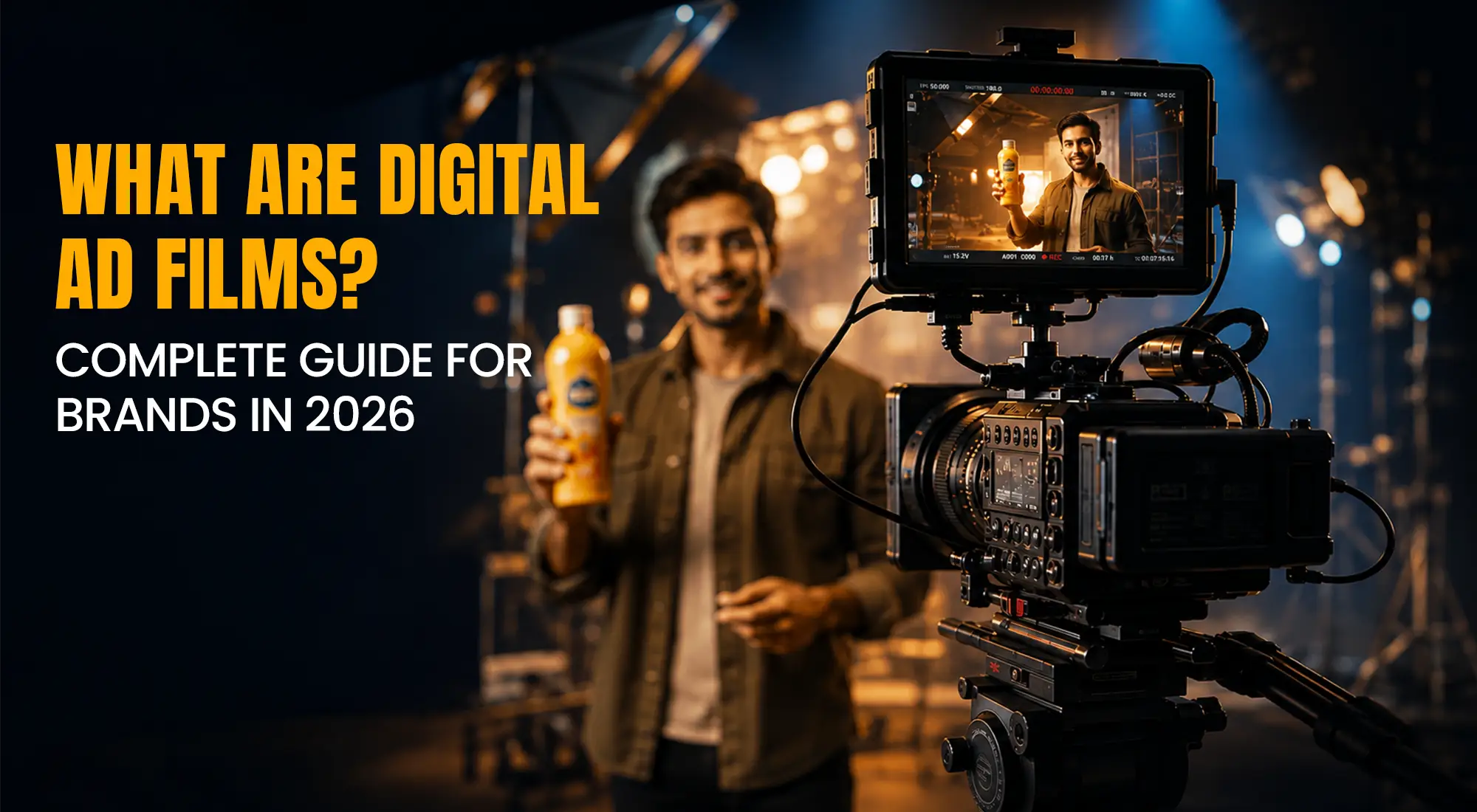
A digital ad film is a video advertisement created specifically for online platforms – social media, streaming, connected TV, and web – rather than for traditional broadcast television. Unlike a TV commercial repurposed for the internet, a true digital ad film is built from the ground up around a platform’s format, audience behavior, and attention window, often in multiple cuts and aspect ratios for different channels.
The key difference from a traditional ad isn’t just where it airs – it’s how it’s designed. A TV ad is built for a captive, seated audience with a 15- or 30-second guaranteed slot. A digital ad film is built for a viewer who can skip, scroll, or swipe away within seconds, so the hook, pacing, and format all have to work harder, faster, and often without sound, since a large share of mobile video is watched muted by default.
______________________________________________________________________________
Evolution of Advertising: From TV Ads to Digital Films
Advertising in India has moved through a few distinct phases over the last two decades:
The single-spot TV era. One 30-second film, one national broadcast slot, and a media plan built around reach – brands like Amul built decades of recall through this model, with its long-running mascot campaign remaining one of the most recognisable in Indian advertising history.
The digital-repurposing era. Brands began uploading their TV commercials to YouTube and social media largely unchanged, treating digital as a distribution channel rather than a distinct format.
The platform-first era. Today’s leading campaigns are built as digital ad films from the outset – Dream11’s 2025 IPL campaign film, for instance, was conceived specifically as social-first, star-driven video content designed to spread across platforms within hours, not as a TV spot with a digital afterthought.
______________________________________________________________________________
Why Digital Ad Films Matter in Modern Marketing
Three shifts explain why digital ad films have moved from “nice to have” to the primary format most brands now build around.
Mobile is where the audience already lives. More than three-quarters of all video content worldwide is now viewed on mobile devices, and U.S. adults spend well over an hour and a half a day watching video on their phones. Brands that only produce horizontal, TV-style creative are optimizing for a viewing habit that’s shrinking, not growing.
Budgets have followed the audience. U.S. digital video ad spending is projected to surpass $80 billion in 2026, growing nearly 20% faster than the total ad market, according to the IAB. Within mobile specifically, in-app video spend is on track to overtake mobile search spend for the first time this year – a signal that advertisers increasingly see video, not search, as the primary way to win attention on a phone.
Attention is scarcer and format-sensitive. Roughly two-thirds of mobile viewers will swipe away from a video that doesn’t engage them within the first three seconds, and vertical video retains dramatically more attention than horizontal video does on mobile screens. A digital ad film that ignores this – slow open, wrong aspect ratio, no reason to keep watching – is competing with one hand tied behind its back before the message even lands.
______________________________________________________________________________
Key Features of Digital Ad Films
Short-Form Storytelling
Most digital ad films are built to land their message fast – often within 6 to 30 seconds for social and performance placements – because mobile viewers decide whether to keep watching within the first few seconds of any video.
Platform-First Formats
A digital ad film built for Instagram Reels typically looks different from one built for YouTube pre-roll – different aspect ratio, different pacing, sometimes an entirely different cut of the same shoot. Producing a single master film and resizing it for every platform generally underperforms content built natively for each one.
Performance-Driven Content
Unlike a traditional TV spot, a digital ad film is measurable almost immediately – views, watch-through rate, click-through, and conversions can all be tracked within days of launch, which lets brands test variants and refine creative in near real-time rather than waiting out a fixed media buy.
______________________________________________________________________________
______________________________________________________________________________
Why Brands Use Digital Ad Films
- Budgets have followed the audience. With digital advertising now the largest share of India’s total ad spend, brands producing only TV-first creative are optimizing for a shrinking share of the media mix.
- Precise, trackable targeting. Digital ad films can be targeted by platform, region, language, and audience interest, and measured against actual engagement and conversion rather than modeled reach.
- Faster iteration. Creative can be tested, paused, or replaced within days, letting brands respond to what’s actually working rather than committing an entire budget to one untested film.
- Reach into regional and Tier II/III markets. As regional-language content adoption grows, digital ad films let brands speak directly to specific-language audiences in a way a single national TV spot never could.
- Lower cost per test. Producing multiple shorter digital films is typically more affordable than a single large-scale TV shoot, letting brands with smaller budgets compete for attention on the same platforms as larger advertisers.
______________________________________________________________________________
Digital Ad Films vs Traditional TV Ads
Select a factor below to compare side-by-side:
______________________________________________________________________________
Key Elements of High-Performing Ad Films
A hook in the first three seconds. Given how quickly mobile viewers decide whether to keep watching, the opening frame and first line of a digital ad film typically carry more weight than any other single element in the edit.
Storytelling, not just selling. Films that lead with a relatable situation or emotional beat before introducing the product tend to hold attention longer than films that open on a product shot or a discount code.
Sound-off clarity. Because a large share of mobile video is watched muted, on-screen text, captions, and visual storytelling need to carry the message on their own, with sound as a layer rather than a requirement.
A clear, single CTA. High-performing ad films typically ask the viewer to do one thing – not three. A film trying to drive awareness, an app install, and a coupon redemption at once usually does none of them well.
Platform-native pacing and format. A cut built for TikTok’s fast scroll behavior rarely performs as well when dropped unchanged into a YouTube pre-roll slot, and vice versa – the strongest-performing campaigns typically produce multiple edits from the same shoot rather than one master cut stretched across every channel.
______________________________________________________________________________
Real Examples of Successful Ad Films
Dream11 – “Aapki Team Mein Kaun?” Built around Bollywood stars Aamir Khan and Ranbir Kapoor in a playful fantasy-cricket rivalry, the film was designed as social-first content that spread rapidly across platforms during IPL season, blending star power with a format built for sharing rather than a single broadcast slot.
Airtel – “Har Ek Friend Zaroori Hota Hai.” While rooted in a long-running TV campaign, Airtel’s friendship-themed advertising extended into social content and user-generated participation, showing how an emotional, culturally rooted idea can be built out across both broadcast and digital formats over time.
Amul – the ongoing mascot campaign. Running since the 1960s, Amul’s topical, real-time commentary format has adapted from print and TV into short, fast-turnaround digital visuals that comment on current events – a useful example of how a decades-old creative idea can still translate into digital-first, rapid-response content.
These examples span very different budgets and objectives, but they share a common thread: each is built around a story or idea strong enough to hold attention on its own, with the platform and format chosen to match how the target audience actually watches.
______________________________________________________________________________
How Brands Use Ad Films to Drive Conversions
Digital ad films drive conversions less through any single “viral” moment and more through a layered, always-on approach:
- Top-of-funnel brand films build initial recognition and emotional association, run broadly across YouTube and social.
- Mid-funnel social and explainer films address specific objections or use cases, often retargeted to viewers who engaged with the brand film.
- Bottom-funnel performance ads carry a direct, urgent CTA to viewers who’ve already shown intent – cart abandoners, page visitors, past customers.
Because digital ad films are trackable in near real-time, brands can see which stage of this funnel is underperforming and swap creative in days rather than waiting out a media buy, which is a structural advantage over traditional TV that compounds over the life of a campaign.
______________________________________________________________________________
How to Get Started with Digital Ad Film Production
- Start with the objective, not the format. Decide whether you need awareness, engagement, or conversion before choosing episode length, platform, or style – the objective should shape the brief, not the other way around.
- Pick your primary platforms first. A film built for Instagram Reels and one built for YouTube pre-roll are rarely the same cut – decide where the film will live before you shoot, not after.
- Write for the first three seconds. Whatever the platform, the opening moment typically determines whether the rest of the film gets watched at all.
- Plan for multiple cuts from one shoot. Budgeting for a 6-second, 15-second, and 30-second version of the same story is usually more efficient than producing entirely separate films for each length.
- Consider regional-language versions early. Given how much of India’s growth in digital advertising is coming from regional content, factoring in vernacular cuts at the planning stage is generally more effective than adding them as an afterthought.
- Work with a production partner who understands platform-native storytelling. Producing content for mobile-first, skippable environments is a genuinely different discipline from traditional TVC production, and briefing a team with that specific experience tends to shorten the path to a working campaign.
______________________________________________________________________________
FAQs
An ad film is a video advertisement built to promote a brand, product, or service. A digital ad film specifically refers to one produced and formatted for online platforms – social media, streaming, and web – rather than traditional broadcast television.
It depends on placement and objective – performance and social ads typically run 6 to 30 seconds to match fast-scrolling attention, while brand films built for YouTube or owned channels can run one to three minutes or longer. Shorter is generally safer on mobile-first platforms, where a large share of viewers decide whether to keep watching within the first few seconds.
A TV commercial is built for a fixed, broadcast slot and a seated audience; a digital ad film is built for a skippable, scrollable, often sound-off mobile audience, and is typically produced in multiple cuts and aspect ratios for different platforms rather than a single master version.
Digital ad films are generally less expensive to produce than a full-scale TV commercial, particularly since a single shoot can often be cut into multiple platform-specific versions rather than requiring one large, standalone production.
Yes, regional-language digital ad films are one of the fastest-growing segments of India’s digital advertising market, driven by rising internet adoption in Tier II and Tier III cities and platforms built around local-language content.
Most industries can use the format, though the objective and style shift – e-commerce and D2C brands lean toward performance-driven films, while healthcare, real estate, and B2B brands often lean toward explainer and trust-building formats.
Ready to Create High-Impact Digital Ad Films?
If you’re looking to create engaging, conversion-driven digital ad films tailored to your brand, now is the time to take action.
A well-planned video strategy can transform your marketing results helping you stand out in a crowded digital landscape and achieve consistent growth.
Let your brand story be seen, heard, and remembered.
🚀 Let’s build videos that don’t just look good – but drive results.
Contact us today to get a customized video strategy for your business.
Call: +91 91525 13159 or Email: sachin@ambestbrandcom.in