
Should You Use Motion Graphics or Animation?
You know your corporate video needs to look engaging.
But then comes the creative decision:
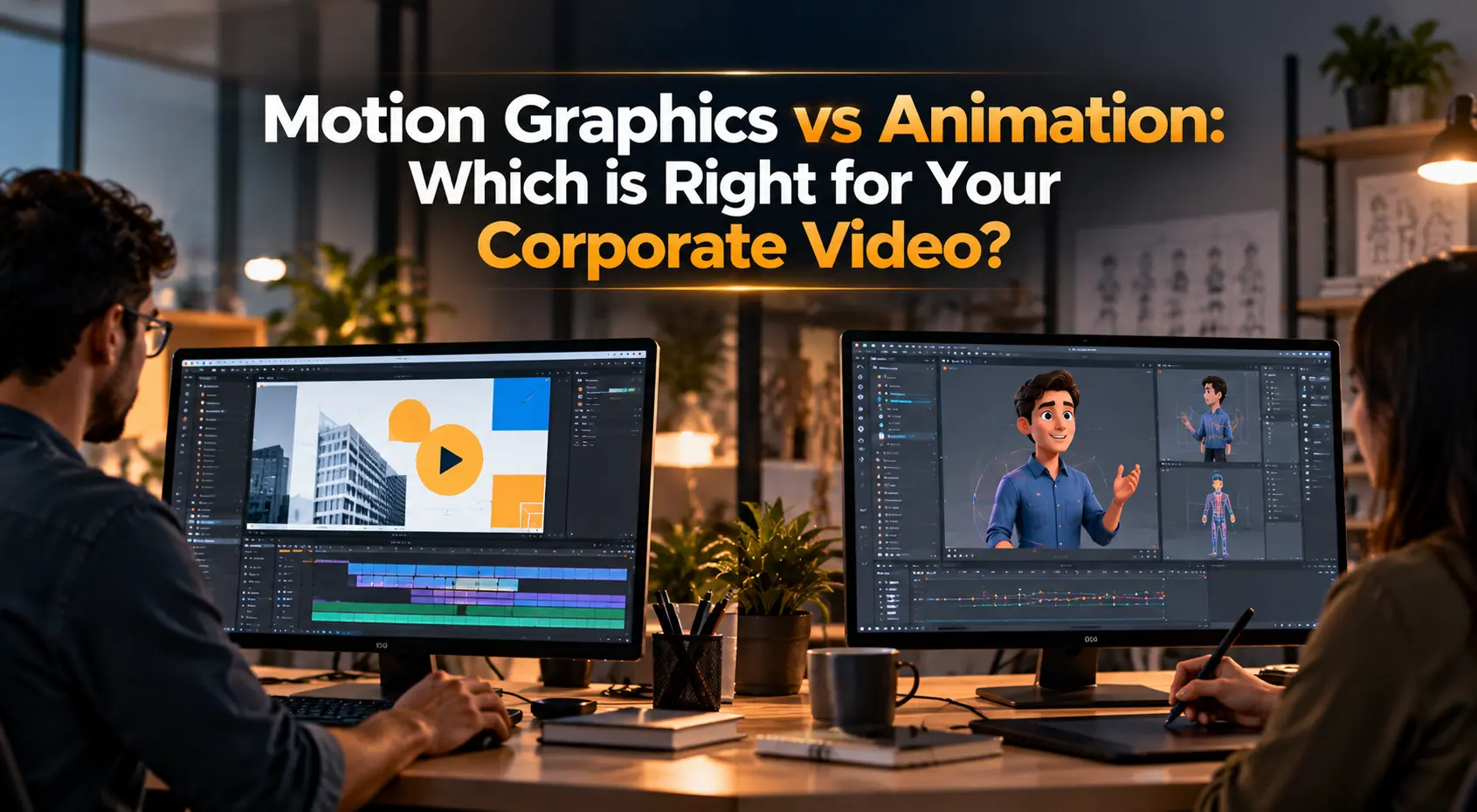
Should you use motion graphics or animation?
The two terms are often used interchangeably, but they aren’t exactly the same. And choosing the wrong format can make a corporate video more complicated, expensive or less effective than it needs to be.
Motion graphics are particularly effective when you need to bring text, data, icons, diagrams, interfaces or abstract business concepts to life. Animation is usually a stronger choice when your message depends on characters, environments, narratives or more expressive visual storytelling.
For many corporate videos, the best solution isn’t choosing one exclusively. A combination of motion graphics, animation and even live-action footage can often communicate the message more effectively.
This guide explains the difference between motion graphics and animation, their costs and use cases, and how to decide which approach is right for your corporate video.
Motion Graphics vs Animation: Quick Answer
Motion graphics primarily animate graphic-design elements such as typography, icons, shapes, charts, illustrations and data. Animation is a broader discipline that can include characters, objects, environments and complete visual stories.
For corporate communication, motion graphics often work well for explaining information, processes, statistics and services.
Animation can be better when storytelling, characters, emotion or complex visual worlds are central to the idea.
Here’s a quick comparison:
| Factor | Motion Graphics | Animation |
|---|---|---|
| Best for | Information and concepts | Stories and visual experiences |
| Common elements | Text, icons, charts, shapes | Characters, objects, environments |
| Corporate explainers | Excellent | Excellent |
| Data visualization | Excellent | Good |
| Character storytelling | Limited | Excellent |
| Product/process explanation | Excellent | Excellent |
| Emotional storytelling | Moderate | Strong |
| Visual complexity | Low to very high | Low to very high |
| Brand communication | Excellent | Excellent |
| Typical corporate use | Explainers, data, processes, presentations | Stories, explainers, campaigns, training |
Neither format is automatically better.
The right choice depends on what you need your audience to understand, feel and do after watching the video.
What Are Motion Graphics?
Motion graphics are graphic-design elements that are animated to communicate information or create visual interest.
Think of a static infographic.
Now imagine the numbers counting upward, icons appearing as the narrator speaks, charts building themselves, text moving across the screen and diagrams visually demonstrating a process.
That’s motion graphics.
Motion graphics can transform information that might otherwise feel dense into something easier to follow.
That’s why they are so useful in corporate communication.
“Our platform connects five business systems through one centralized workflow.”
You can visually show those five systems connecting to a central platform.
The viewer doesn’t just hear the explanation.
They see how it works.
What Is Animation?
Animation is the broader process of creating the illusion of movement through sequential images or digitally generated objects.
Technically, therefore, motion graphics are a type of animation.
But in everyday corporate-video terminology, “animation” usually refers to more illustrative or story-driven content involving characters, environments, products or complete scenes.
Motion graphics might show:
User → Network → Server → Threat Detection → Security Response
An animated film could instead follow a character opening a suspicious email and visually take the audience inside the system to show how the threat spreads.
Same broad subject.
Completely different storytelling approach.
What Is the Main Difference Between Motion Graphics and Animation?
The biggest difference is usually communication style.
“How can we visualize this information?”
“How can we tell this story visually?”
That distinction isn’t absolute, but it’s a useful starting point.
“We reduced processing time by 43%.”
Motion graphics can animate the number, show a before-and-after comparison and visualize the improvement with a chart.
Now suppose your company wants to communicate:
“Our solution gives employees more time to focus on meaningful work.”
Animation could follow an employee struggling with repetitive tasks before showing how their working day changes after adopting the solution.
The first requirement is primarily information visualization.
The second is storytelling.
Motion Graphics vs Animation for Corporate Videos: Detailed Comparison
1. Explaining Complex Information
Motion Graphics: ExcellentBusinesses frequently need to explain things that can’t easily be filmed.
A camera cannot literally film data moving through a cloud infrastructure. Motion graphics can visualize it. That makes motion graphics particularly useful for B2B and technology companies.
Animation: ExcellentAnimation is equally capable of explaining complexity but can provide more narrative freedom. Instead of simply showing how a system works, animation can create a scenario around the problem.
2. Data and Statistics
Winner: Motion GraphicsCorporate videos often contain numbers.
A narrator reading these statistics can quickly become monotonous. Motion graphics can turn numbers into visual proof.
27 countries can become an animated world map.
2 million users can become a dynamic visualization of growth.
38% improvement can become an animated comparison.
The goal isn’t decoration. It’s visual comprehension.
3. Storytelling
Winner: AnimationAnimation provides greater freedom when your video needs characters, scenarios and narrative development.
A character can represent your customer’s problem. An animated environment can simplify an otherwise complicated situation. Visual metaphors can explain abstract concepts.
A product can explode into its individual components.
Data can become a landscape.
A supply chain can become a visual journey across the world.
When storytelling drives the communication, animation can be incredibly powerful.
4. Brand Personality
Winner: BothMotion graphics can be built directly around your brand identity.
can all become part of the motion design.
Animation can go even further by creating an entire visual universe around the brand. Characters, environments and illustration styles can become distinctive brand assets.
A financial-services organization may prefer sophisticated motion graphics.
A consumer-facing technology brand might use more expressive animation.
A manufacturing company could combine technical 3D animation with motion graphics.
There is no universal formula.
5. Human Emotion
Winner: Animation — but context mattersCharacters can create emotional connection. We naturally relate to people—even illustrated ones.
If the corporate video needs to demonstrate frustration, relief, excitement, ambition or transformation, character animation can communicate those emotions clearly.
However, there is another option.
Use real humans.
If authenticity is critical, live-action footage combined with motion graphics may be more effective than fully animated content.
That creates both: Human credibility + visual clarity.
6. Production Flexibility
Winner: Both, depending on the projectAnimation and motion graphics have one major advantage over live-action production:
You aren’t always dependent on physical locations, weather, actors or production schedules.
But revisions aren’t necessarily effortless.
Changing a number in a simple animated graphic may be easy. Changing a fully animated character scene after it has been designed, animated and rendered may require substantial work.
That’s why professional pre-production matters.
Approving the creative direction before full production can prevent expensive changes later.
7. Cost: Is Motion Graphics Cheaper Than Animation?
Sometimes—but not always.
Simple motion graphics are generally less production-intensive than complex character or 3D animation.
A sophisticated 60-second motion-design film can require more work than a simple two-minute animated explainer.
Ask: “What visual approach communicates our message effectively within our available budget?”
When Should You Use Motion Graphics in a Corporate Video?
Motion graphics are particularly effective when the communication is information-heavy.
Present data: Turn statistics into animated charts, maps and infographics.
Explain software or technology: Visualize interfaces, workflows, integrations and technical architecture.
Communicate company achievements: Transform milestones and numbers into an engaging visual story.
Enhance live-action footage: Add titles, callouts, data, product features and branded graphics over filmed content.
Create executive presentations: Motion graphics can support leadership communication by making key information easier to understand.
Explain abstract services: Consulting, finance, technology and other service businesses often sell things that can’t physically be filmed.
Motion graphics make the invisible visible.
When Should You Use Animation in a Corporate Video?
Animation becomes particularly useful when your message needs storytelling or visual imagination.
Explain a complex product: Show internal components or processes that a camera cannot capture.
Build an animated brand world: Develop a distinctive visual style associated with your organization.
Create training content: Characters and scenarios can demonstrate workplace situations in an accessible way.
Explain abstract concepts: Turn ideas such as cybersecurity, sustainability, finance or digital transformation into understandable visual metaphors.
Demonstrate future concepts: Animation can visualize products, facilities or technologies that don’t physically exist yet.
What About 3D Animation & Hybrid Production?
What About 3D Animation?
For some corporate videos, neither standard motion graphics nor 2D character animation is enough. That’s where 3D animation becomes valuable.
Imagine needing to show what happens inside an industrial machine while it’s operating. Physically filming it may be impossible. 3D animation can virtually open the machine, move through its internal components and show the process step by step.
For technical industries, that can turn a complicated explanation into an intuitive visual experience.
Can You Combine Motion Graphics and Animation?
Absolutely. In fact, many effective corporate videos do.
The viewer doesn’t care whether a sequence is technically categorized as motion graphics, 2D animation or 3D animation. They care whether the video is:
The creative technique should serve the communication—not the other way around.
Motion Graphics + Live Action: Another Powerful Combination
Corporate video doesn’t have to be either filmed or animated.
“Over the past three years, we’ve expanded into 18 markets.”
As they speak, an animated map appears alongside them.
Then:
“We’ve helped more than 500 enterprise customers.”
The number appears dynamically with supporting graphics.
The CEO provides human credibility.
The motion graphics provide visual clarity.
How to Choose Between Motion Graphics and Animation
Before deciding, answer these questions.
1. What does the audience need to understand?
If the answer involves data, processes or systems, motion graphics may be enough. If it involves a scenario, journey or story, animation may work better.
2. Does the video need characters?
If characters are central to the concept, animation is the natural choice.
3. How important is data?
If numbers and statistics carry the message, motion graphics can make them easier to absorb.
4. Does the audience need to see a real person?
If trust and authenticity are important, consider live action supported by motion graphics.
5. Is the product difficult to film?
For machinery, architecture, medical devices or internal technical processes, 3D animation may be the better option.
6. Where will the video be used?
A corporate website video may require a different approach from:
7. What is the business objective?
This is the most important question.
Then choose the visual technique.
Motion Graphics vs Animation: Which Is Better for B2B Companies?
For many B2B companies, motion graphics are particularly effective because B2B communication often involves complicated information:
But that doesn’t mean animation isn’t suitable for B2B. Animation can make technical subjects more approachable and create memorable stories around customer problems.
Motion graphics to explain how its platform integrates with existing systems.
Animation to demonstrate the customer’s journey before and after implementation.
Live action to feature a genuine customer testimonial.
The strongest corporate video may combine all three.
Motion Graphics vs Animation: Which Is Better for Corporate Video ROI?
Neither format guarantees better ROI.
A highly polished animation can fail if nobody understands the message. A simple motion-graphics video can generate enquiries if it explains a customer’s problem clearly and presents a compelling solution.
The best corporate video isn’t necessarily the one with the most animation. It’s the one that makes the message easiest to understand and act upon.
Motion Graphics vs Animation: Final Verdict
So, which should you choose for your corporate video?
Choose animation when your message benefits from characters, scenarios, visual storytelling or environments that would be difficult to film.
Choose 3D animation when you need to demonstrate products, machinery, architecture or technical processes in detail.
Combine live action, motion graphics and animation when your project requires both human authenticity and visual explanation.
Ultimately, the best approach isn’t determined by what looks most impressive.
It’s determined by: What will help your audience understand your message—and remember your brand?
Need Help Choosing the Right Style for Your Corporate Video?
You don’t need to decide whether you need motion graphics, 2D animation, 3D animation or live action before speaking to a production partner.
Start with the communication challenge.
Ambest Brandcom can help translate your objective into the right visual approach.
Whether the project requires a corporate film, motion-graphics video, animated explainer, 3D product animation or a combination of techniques, the process should begin with the same question:
What does your audience need to understand, feel or do?
From there, the right production style becomes much clearer.
Share your brief, target audience and communication objective with Ambest Brandcom.
We’ll help you determine whether motion graphics, animation, live action—or a combination of all three—makes the most sense for your project.
Frequently Asked Questions About Motion Graphics vs Animation
Motion graphics generally focus on moving graphic-design elements such as text, icons, shapes, charts and data. Animation is a broader category that can include characters, objects, environments and narrative storytelling. Motion graphics themselves are technically a form of animation.
Motion graphics are often better for corporate videos that need to explain data, processes, statistics, software or abstract business concepts. Animation may be more appropriate when the message requires characters, scenarios, emotion or narrative storytelling.
Simple motion graphics can be less expensive than complex character or 3D animation, but pricing depends on duration, design complexity, number of scenes, illustration requirements, revisions and other production factors.
2D animation is often suitable for explainers, character stories, training and conceptual communication. 3D animation can be more appropriate for products, machinery, architecture and technical processes where depth and physical detail are important.
Yes. Motion graphics can be added to live-action footage to display statistics, titles, diagrams, maps, product information and other visual explanations. Combining real people with motion graphics can provide both authenticity and clarity.
Yes. Motion graphics are particularly useful for B2B companies because they can simplify complex products, processes, services, data and technology. They are commonly used in SaaS, finance, manufacturing, healthcare and technology communication.
There is no universal ideal length. The appropriate duration depends on the video’s purpose, audience, platform and complexity of the message. A social-media explainer may need to be very short, while a technical product explanation or training video may require considerably more time.
Yes. 2D and 3D animation can visualize processes, internal components and technical concepts that may be difficult or impossible to capture with a camera.
Motion graphics are particularly effective for process-, data- and information-led explainers. Character or illustrative animation can be more effective when the explainer uses a customer story or scenario. Many explainer videos combine both techniques.
Look beyond the showreel. Evaluate whether the company understands your business objective, audience and message. A strong production partner should recommend the visual technique based on the communication problem rather than pushing one production style for every project.
🚀 Let’s build videos that don’t just look good – but drive results.
Contact us today to get a customized video strategy for your business.
Call: +91 91525 13159 or Email: sachin@ambestbrandcom.in